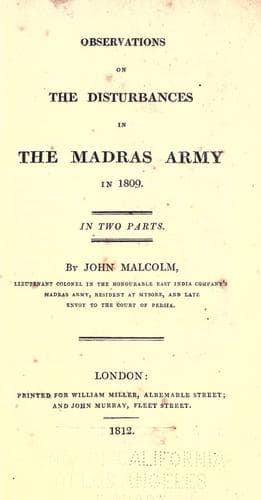
Observations on the Disturbances in the Madras Army in 1809Malcolm, John
History
Observations on the Disturbances in the Madras Army in 1809
Malcolm, John
India. Army -- History; Malcolm, John, 1769-1833
Lieutenant and Adjutant Nixon informs Lieutenant-Colonel Malcolm,
that the best opinion he can form, from his communication with
confidential men, is, that the non-commissioned, rank and file, of the
Madras European regiment, were alarmed in consequence of the measures
adopted towards their officers, Lieutenants D. Forbes and Maitland,
and the threat held out in the Adjutant-General's letter, (published
in the regimental orderly book,) lest the most severe penalty might
be inflicted on the regiment; conjecturing that they must either
be disbanded, transported, or other ways disposed of, by way of
punishment, on a repetition of similar conduct of their officers. To
use their own expression, it was a general saying, "that they might as
well order out one of us to be flogged or hanged up:" and certainly,
in my opinion, from that period great discontent prevailed amongst the
men. This discontent considerably increased from the order respecting
the marines nominating Lieutenant Maitland in particular, and directing
Lieutenant D. Forbes to proceed to Penang; and afterwards by two other
detachments being ordered on marine service, to which they said, that
they did not enlist to come to India as marines. They were also led
to believe, from the ship's boat that landed here, that no marines
were required for the ships in the roads, but that they wanted seamen
only, and consequently supposed they were to be turned over to the
navy. These points were most deeply impressed upon their minds by a
communication which was believed to have come from the high authority
of the Commander-in-Chief, that the regiment was to be disbanded, and
the officers put on half pay, in case Lieutenant Spankie should not
accept of the station of quarter-master.
Lieutenant Nixon further states, that considerable discontent exists in
consequence of the great number of men in the regiment who enlisted for
general service, "time unlimited," prior to Mr. Windham's act; and that
they consider it a hardship that they should not be admitted to the
full benefit of the act in point of limited service.
Another cause of discontent is, that the regiment has not its tour of
duty in the field, and change of station, with his Majesty's corps.
Masulipatam,
21st July, 1809.
No. XIV.
EXTRACT _from a Letter dated 28th May, 1809_.
TO LIEUTENANT NIXON,
ADJUTANT MADRAS EUROPEAN REGIMENT.
SIR,
Public-domain text, read in full here on John Shaqi.
Reviews
Reviews
No reviews yet
Be the first to share your thoughts on this work.
Elsewhere in the archive
Join the Discussion
Join the discussion
Sign in to leave a comment or review.
Sign InorCreate an account