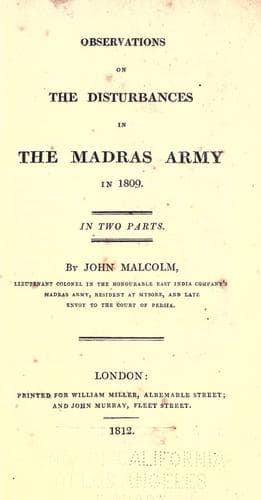
Observations on the Disturbances in the Madras Army in 1809Malcolm, John
History
Observations on the Disturbances in the Madras Army in 1809
Malcolm, John
India. Army -- History; Malcolm, John, 1769-1833
I have, in my observations on the disturbances at Madras, said little
on the question of the suspension of Colonel Capper and Major Boles;
but I conceive all that the reviewer has said upon that subject will be
deemed by those who consider it attentively, as more ingenious than
solid. The whole of that discussion would appear to resolve itself into
a very short question. The act of disobedience to his superior, in a
military officer or soldier, can alone be justified in a case where the
civil law would punish his obedience. A great deal must of course be
decided by the circumstances of the moment. "To your tents, O Israel!"
would, in the present state of Great Britain, be an unobjectionable
text. It certainly was not so in the reign of Charles the First. But
we have only to suppose Major Boles on his trial before a civil court,
for publishing, or aiding in the publication, of a seditious libel.
Among the circumstances to be considered in such a case, that prompt
and undeliberate obedience which it is the habit of an officer to give
to the orders of his superiors, would assuredly be one of the most
prominent; and an English jury would, I imagine, be slow in condemning
an officer situated as Major Boles was. They would probably think,
that the great and vital principle of prompt obedience, on which
the existence of that armed force which guarded the civil community
depended, was of too important and sacred a nature to have its plain
meaning frittered away by casuists and lawyers. These reflections
would certainly lead plain men to decide, that we ought not to refine
too much upon such delicate points, and that no military order should
be disobeyed, the illegality of which was not of so obvious a nature
as to be clear to the most common understanding. But, after all, the
justice or injustice of this act of authority is but a small part of a
very large question. The wisdom and policy of the measure, (which is
the point on which the character of the Government of Fort St. George
is chiefly concerned,) appear, however, to be given up even by those
who are the warm advocates of many other parts of that system which was
pursued.
Public-domain text, read in full here on John Shaqi.
Reviews
Reviews
No reviews yet
Be the first to share your thoughts on this work.
Elsewhere in the archive
Join the Discussion
Join the discussion
Sign in to leave a comment or review.
Sign InorCreate an account