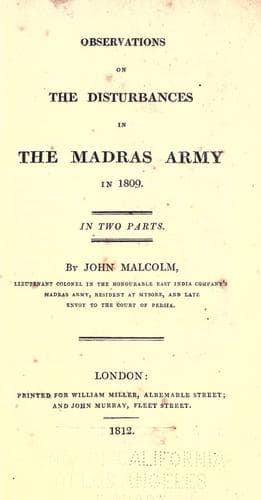
Observations on the Disturbances in the Madras Army in 1809Malcolm, John
History
Observations on the Disturbances in the Madras Army in 1809
Malcolm, John
India. Army -- History; Malcolm, John, 1769-1833
The writer of the review traces what he deems an exact similarity of
character between Sir George Barlow's measures and those adopted by
Lord Clive, in 1766, to quell a sedition among the officers of the
Bengal army; and infers, from a general and sweeping conclusion, that
the reputation of these two Governors must stand or fall by the same
arguments. To those who are satisfied with the superficial and general
facts,--that both Lord Clive and Sir George Barlow exercised power in
India, that there were discontents and combinations among a part of
the European officers of the native troops during their respective
administrations, which terminated, on both occasions, in submission to
authority,--the observations made in the Quarterly Review on this part
of the subject will be satisfactory, and conclusive: but to such as
examine the particulars of these two important events, and trace to its
true cause the defection of the officers of the Bengal army in 1766,
and then observe the open, military, and manly conduct of Lord Clive,
there will appear much more grounds for a contrast than a comparison.
The conduct of the officers of the Bengal army, their limited number,
and the actual constitution of the native army[34] at that period of
our dominion in India, make a still wider difference in all those
considerations, that render the late measures of the Government of
Madras, as they affect the personal attachment and fidelity of the
sepoys to their European officers, dangerous to our future security.
But supposing the difference in this respect did not exist, Lord
Clive, when actually engaged in war, might have been compelled, by the
conduct of officers, which the situation of affairs rendered doubly
disgraceful, to adopt a measure that was most deeply injurious to
those principles upon which our empire is founded. We have escaped
this danger; but is that any reason for incurring a similar hazard?
It has never been stated that the danger from weakening the respect
and attachment of the sepoy for his officer was inevitable, and must
be destructive to our power within a specific period. Its alarming
tendency has been shown: and it is this which must be disproved, and
the _absolute necessity_ of having had resort to it established, before
the course pursued in this instance by the Government of Fort St.
George can be efficiently defended.
Public-domain text, read in full here on John Shaqi.
Reviews
Reviews
No reviews yet
Be the first to share your thoughts on this work.
Elsewhere in the archive
Join the Discussion
Join the discussion
Sign in to leave a comment or review.
Sign InorCreate an account