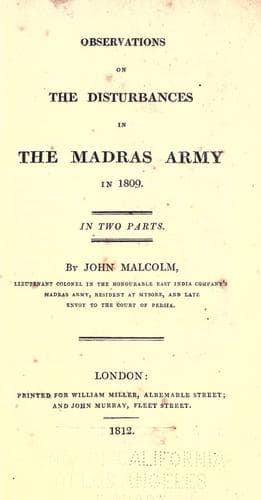
Observations on the Disturbances in the Madras Army in 1809Malcolm, John
History
Observations on the Disturbances in the Madras Army in 1809
Malcolm, John
India. Army -- History; Malcolm, John, 1769-1833
The reviewer appears resolved to deny every fact that can even palliate
the guilt of the officers of the Madras army. He terms their desire to
submit to Lord Minto a difference in point of form, "a saving to their
pride, not to their consciences;" and he is amused with the assertion,
that the love of their country had a decided operation in defeating
their guilty proceedings. The man who reasons thus coolly upon such
events, has probably never witnessed a scene at all resembling that
of which he treats; or he would have discovered, that when passion
seizes that ground which reason has abandoned, men act more under
the influence of feelings than forms; and with minds deluded, but
not debased, they make a vain attempt to reconcile the most opposite
principles of conduct, and fall, _self-subdued_, by those virtues which
are implanted too deeply in their hearts to be eradicated by the sudden
action, however violent, of a guilty but transient impulse.
The able writer in the review conceives that he has at once discovered
the chief cause of the late disturbances, and the best apology for
the Company's officers concerned in them, in the constitution of the
Company's service, and the habits of those that belong to it. The
atmosphere they imbibe is calculated, in his opinion, to relax all just
ideas of subordination; and they are, he infers, predisposed, from
such causes, to an opposition to the authority placed over them. Some
disposition to resistance may no doubt be found in every community,
civil as well as military, that ever existed; and to the existence of
this universal and natural feeling every excellence of human government
may be traced. But let us suppose that this disposition had, from
local circumstances and other causes, attained such a degree among the
Company's officers in India, as to threaten the public tranquillity;
what does this prove? It is, _if true to the extent stated in the
review_, not an excuse for those who produced that crisis which has
been described; but an eulogium, and a very high one, upon the wisdom
and vigour of those rulers of our Indian possessions, who have not
only repressed this disposition to opposition, but have rendered
those to whom it is ascribed the instruments of the advancement of
the interests and glory of their country: and a reflecting man would
probably find much more to admire, than condemn, even in that case[35]
which is triumphantly brought forward to prove this assertion. When
events led a wise and moderate Governor-General[36], and an able and
politic Indian minister[37], to prefer a course which certainly made
many and important sacrifices of ordinary maxims of rule, but which led
to a quiet and just settlement of all complaints; to the pursuit of a
severe, inflexible system, which (anxious only for its own character)
defends a principle at the hazard of a state: most persons, when they
contemplated the great end, would at least pardon the means by which
Public-domain text, read in full here on John Shaqi.
Reviews
Reviews
No reviews yet
Be the first to share your thoughts on this work.
Elsewhere in the archive
Join the Discussion
Join the discussion
Sign in to leave a comment or review.
Sign InorCreate an account