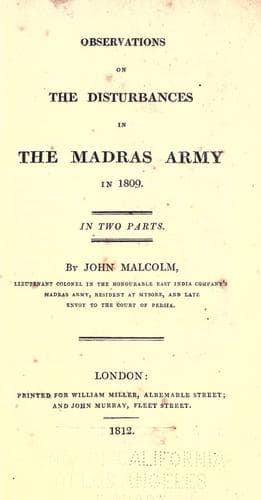
Observations on the Disturbances in the Madras Army in 1809Malcolm, John
History
Observations on the Disturbances in the Madras Army in 1809
Malcolm, John
India. Army -- History; Malcolm, John, 1769-1833
He will be compelled (though perhaps reluctantly,) to abandon some
abstract ideas regarding the beauty of general principles, which he
may have long and fondly cherished, and to confess the force of that
observation which experience taught Mr. Burke to make, upon all such
general questions--"I have lost," said that great orator and statesman,
"all confidence in your swaggering majors, having always found that the
truth lurked in the little minor of _circumstances_."
In the conclusion of the article of the review the writer animadverts
on the description given by Mr. Petrie of the cold and repulsive
manners of Sir George Barlow; and in observing upon this "deficiency
in the charm of demeanour," though he admits it must subtract from
the influence of a statesman, he makes an allusive comparison (on the
ground of common defects) between his character and that of some
of the greatest names in history[38], who, notwithstanding their
defective manners, have, by the force of their superior genius, been
able to command the support of mankind: and, to give more effect to
this allusion, the reviewer quotes a public dispatch from Lord Minto,
in which that nobleman ascribes the great unpopularity of Sir George
Barlow to "a pure and inflexible discharge of ungrateful, but sacred
and indispensable duties." Self-defence has alone compelled me to
discuss the acts of Sir George Barlow. On his character my opinion
was long ago formed. It will be seen, that at the commencement of
these disturbances I confidentially stated that opinion[39]. I then
represented him as a man of excellent talent, of unsullied integrity,
of indefatigable industry, and distinguished by long and meritorious
services to the Company. I still retain that opinion; and no injustice
of which he may be guilty towards me, shall ever prevent me from
expressing it. I then foresaw that the defects of his character would,
in his situation, probably produce very pernicious consequences. My
opinion has been confirmed by the event. Experience seems to me to
have most fully proved, that the very qualities which eminently fit
a man for subordinate situations, may unfit him for the supreme; and
that the rules which are necessary to the good order of many of the
inferior departments, may, in their undistinguishing application, prove
destructive in the general administration of a great state.
FOOTNOTES:
[1] I was, at the moment this letter was written, at Madras, preparing
to proceed on a mission to Persia: not a word even of dissatisfaction
at my conduct was expressed--no explanation of any of my acts required;
and, consequently, no opportunity afforded of defending myself against
the serious charges that were thus secretly transmitted to England. The
letter to the Secret Committee is dated the 10th September, 1809, the
day before that on which Lord Minto arrived at Madras.
[2] Cicero's Letters to his Friends, Vol. I. p. 194. Octavo. London,
1753.
Public-domain text, read in full here on John Shaqi.
Reviews
Reviews
No reviews yet
Be the first to share your thoughts on this work.
Elsewhere in the archive
Join the Discussion
Join the discussion
Sign in to leave a comment or review.
Sign InorCreate an account