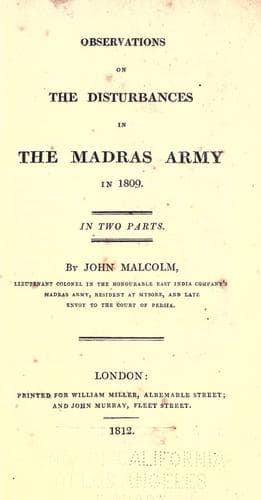
Observations on the Disturbances in the Madras Army in 1809Malcolm, John
History
Observations on the Disturbances in the Madras Army in 1809
Malcolm, John
India. Army -- History; Malcolm, John, 1769-1833
[3] As if an unqualified refusal to forward these Memorials was not
adequate to produce this dangerous effect, the names of all the
officers who had signed the first Memorial were placed on a proscribed
list, and deemed ineligible to any promotion in commands or staff
situations. One fact will show the impression that this act made upon
the most moderate. I wrote to Colonel Aldwell Taylor, an officer of
high rank and respectability, expressing my earnest desire to see him
placed in a command in which I thought his principles and character
would be useful to Government. In his answer, which is dated the 29th
of July, he details the causes of his being in a situation of actual
retirement. When he had applied for a command to which his services
gave him a right to aspire, he observes, that he was informed of the
crime by which he had not only forfeited all hope of that particular
station, but also (he adds), "that for having affixed my signature to a
respectful address to my superiors and employers, I was placed at the
head of a list of names comprising nearly two thirds of the army, and
thereby marked by the extreme displeasure of Government, and thence
deprived of every future hope of situations of honour and emolument.
Whilst smarting under these most serious injuries, I felt it impossible
to resume the command of Masulipatam, and made application to retire."
This case is more marked than others of the same kind, because there
can be little, if any doubt, the violent mutiny that took place at
Masulipatam would never have occurred, if Colonel Taylor had remained
in command of that garrison. The nature of this unavowed punishment
(for though there is, I imagine, no doubt such a resolution was passed
by Government, it was never published in any order,) is very peculiar;
but it is very characteristic of the system of measures pursued. It was
teasing and aggravating in its operation, without efficiency in its end.
[4] Vide the preceding note.
[5] Vide Mr. Pigott's Opinion, printed with the Memorial of Major Boles.
[6] This crude and violent address was never transmitted to the
Governor General. The crime laid to the charge of the officers here
mentioned, was being implicated in framing it and in promoting its
circulation.
[7] There may be some rare exceptions to this rule, which apply to
secret confederacies against a state, where the object is to _deprive
an individual of power, more than to punish as an example_. This
consideration could, on the 1st of May, have hardly applied even as a
fair pretext to any one individual of the many that were punished.
[8] In this officer's case there was no impropriety or disrespect in
the letter, that could have aggravated the offence; and the motive
which made him state what he had done, was assuredly honourable.
[9] It is, of course, meant the most moderate among those who were at
all discontented.
Public-domain text, read in full here on John Shaqi.
Reviews
Reviews
No reviews yet
Be the first to share your thoughts on this work.
Elsewhere in the archive
Join the Discussion
Join the discussion
Sign in to leave a comment or review.
Sign InorCreate an account