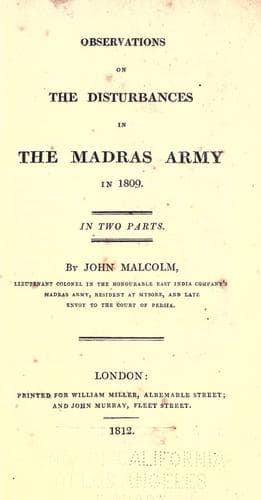
Observations on the Disturbances in the Madras Army in 1809Malcolm, John
History
Observations on the Disturbances in the Madras Army in 1809
Malcolm, John
India. Army -- History; Malcolm, John, 1769-1833
I was not discouraged by that strong disinclination which I observed
in Sir George Barlow to credit every information I gave him upon this
subject, but continued to press upon him the urgency of the case, and
to entreat him to adopt measures calculated to remedy so desperate and
general an evil, before it had attained that maturity to which it was
fast approaching. The great and generous object was, I said, to save,
not to destroy, a body of brave and meritorious, though infatuated
men, who were rushing upon their own ruin. They had (I not once, but a
hundred times repeated to Sir George Barlow,) a more serious quarrel
than that with Government, they had quarrelled with themselves; and,
unless he could adopt some measure that would restore them to their
own good opinion, every attempt to establish order and subordination
would be vain, as they were goaded on to further guilt by a torturing
sense of that into which they had already plunged. On being, at one
of these conferences, desired by Sir George Barlow to suggest what I
thought would promote this end, I proposed (if the expedient had his
approbation,) to draw up an address to him from the Company's officers
on direct opposite principles to those seditious papers that I knew
were then in circulation; and to give, by this measure, a shape to
that feeling which still existed in the army, but which was scattered,
and, from having no union, was repressed by the combined action of the
discontented and turbulent. This address was as follows:
"We, the undersigned officers of the Madras establishment, trust that
the very extraordinary and unprecedented situation in which we are
placed by some recent occurrences, will plead our excuse for an address
which has no object but that of vindicating ourselves, as a body,
from those serious imputations to which we conceive it possible we
may become liable, from the nature of late proceedings in the army to
which we belong; and to assert our devoted allegiance to our King, our
unalterable attachment to our Country, and our consequent respect and
submission to the laws and acts of that local Government under which we
are placed, and whose commands it is our duty, under all circumstances,
to obey, as those of a legitimate branch of the constitution of our
country.
Public-domain text, read in full here on John Shaqi.
Reviews
Reviews
No reviews yet
Be the first to share your thoughts on this work.
Elsewhere in the archive
Join the Discussion
Join the discussion
Sign in to leave a comment or review.
Sign InorCreate an account