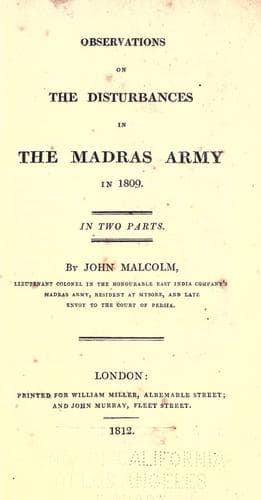
Observations on the Disturbances in the Madras Army in 1809Malcolm, John
History
Observations on the Disturbances in the Madras Army in 1809
Malcolm, John
India. Army -- History; Malcolm, John, 1769-1833
state by something short of concession. Sir George Barlow has rather an
exaggerated opinion of my personal influence; and he thinks, I believe,
it will effect what I only expect from the united good feeling of the
army. I have, however, done all I can; and shall continue, under all
circumstances, my most ardent efforts in the cause of good order and
government."
I heard, towards the end of June, of some extraordinary proceedings
that had taken place regarding the European regiment stationed at
Masulipatam, in consequence of a dispute between the Lieutenant-Colonel
commanding and the officers of the corps. The substance of these
proceedings[44] may be given in a few words. Lieutenant-Colonel Innes,
the day after he joined the regiment (the 7th of May), dined at the
mess, where a toast was given, "The friends of the army;" to which
he objected, and proposed it to be changed for one of less equivocal
meaning--"The Madras army." This was not assented to, and he left
the table. Next day he wrote an account of this circumstance to
head-quarters, but _desired it should not be noticed_, as he expected
an apology from those officers whose conduct he considered as most
disrespectful. The moment his letter reached Madras, an order was
transmitted, directing Lieutenant David Forbes, who was said to be the
person who had given the toast, to proceed, at a few hours' warning, to
the Fort of Condapilly, a solitary and far from healthy post, at the
distance of forty miles, and one at which there was not _one_ man of
the corps to which he belonged. Lieutenant Maitland, who was reported
to have seconded the toast, was, by the same order, deprived of his
station of Quarter-Master. These measures, combined with an imprudent
declaration of Colonel Innes, that the corps would be disbanded if a
young officer refused to accept the vacant station of Quarter-Master,
(by which probably it was only meant that that event might be
apprehended, if such a spirit of insubordination continued,) threw the
officers of the regiment into a great ferment, and led to their making
a representation to head-quarters, earnestly soliciting the benefit of
regular military trial, and deprecating the disgrace to which they were
exposed from such punishments being inflicted, without the slightest
opportunity being given to individuals of vindicating themselves from
the private accusations made against them.
Public-domain text, read in full here on John Shaqi.
Reviews
Reviews
No reviews yet
Be the first to share your thoughts on this work.
Elsewhere in the archive
Join the Discussion
Join the discussion
Sign in to leave a comment or review.
Sign InorCreate an account