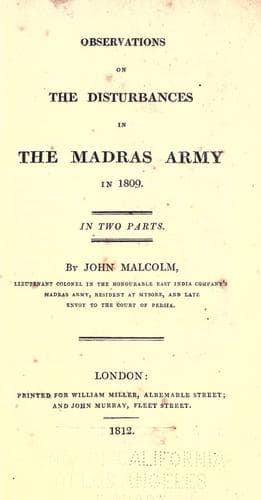
Observations on the Disturbances in the Madras Army in 1809Malcolm, John
History
Observations on the Disturbances in the Madras Army in 1809
Malcolm, John
India. Army -- History; Malcolm, John, 1769-1833
"To this apparent unreasonable forbearance and attention to the
feelings of the officers, who had, by their acts of violence and
aggression, forfeited all claims to such consideration, may, we
conceive, be ascribed Lieutenant-Colonel Malcolm's failure in the
establishment of any efficient control over the garrison: and he
appears to have been principally occupied, during the period of
his residence at Masulipatam, in negociations with the disorderly
committees; calculated, in our opinion, to compromise rather than
establish his authority; and in fruitless attempts to induce them, by
argument, to return to their duty, and abandon the criminal combination
in which they had engaged. Lieutenant-Colonel Malcolm's reasons for
pursuing this line of conduct, and for recommending to us the adoption
of conciliatory and temporizing measures, are detailed in his letters
to our President, dated the 4th, 5th, and 6th of July. In those letters
he states, that the officers at Masulipatam had received assurances
from most of the military stations of the army, applauding their
conduct, and promising them effectual support; that the whole army were
united in a resolution to oppose the authority of Government; that
there was not a single corps, from Ganjam to Cape Comorin, which was
not prepared to break out into open rebellion. The measures recommended
by Lieutenant-Colonel Malcolm, as constituting, in his opinion, the
only means of averting the most dreadful calamities, consisted of a
modified repeal of the orders of the 1st of May; the restoration to
the service, and to their appointments, of all the officers whom we
had found it necessary to suspend or remove; with an intimation to the
army, that their claims to Bengal allowances would be brought to the
notice of the Honourable the Court of Directors. Lieutenant-Colonel
Malcolm returned to Madras, on the arrival of Major-General Pater at
Masulipatam to assume the command of the northern division of the
army, having succeeded no further in accomplishing the objects of his
mission, than in preventing the officers from adopting any flagrant
acts of outrage to authority during his residence at Masulipatam."
Public-domain text, read in full here on John Shaqi.
Reviews
Reviews
No reviews yet
Be the first to share your thoughts on this work.
Elsewhere in the archive
Join the Discussion
Join the discussion
Sign in to leave a comment or review.
Sign InorCreate an account