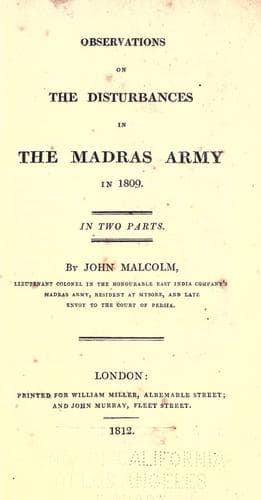
Observations on the Disturbances in the Madras Army in 1809Malcolm, John
History
Observations on the Disturbances in the Madras Army in 1809
Malcolm, John
India. Army -- History; Malcolm, John, 1769-1833
corroborate and establish the truth of that unqualified assertion,
which I have deemed it due to my character to make on this point. A
letter from Lieutenant-Colonel Barclay[53], dated the 12th of July, and
written by the Governor's order, in reply to my communications from
Masulipatam of the 4th, 5th, and 6th of July, in which I had required
further orders, repeats nearly the same sentiments in the same language
Sir George Barlow had used before I left Madras. "You cannot," he
observes, "render a more acceptable service to the public interests,
than by the exertion of your influence and ability in keeping the
garrison of Masulipatam firm to their duty, and _satisfying the
officers_ that it is not less for their interests than it is consistent
with their duty, to await the decision of the authorities in England on
the several questions which have occasioned so much agitation in the
minds of a considerable portion of the army of this establishment."
The same officer wrote to me a short letter on the 20th of July, in
which he repeats these sentiments, and concludes by stating, that the
greatest service I could render my country, in the actual situation of
affairs, was "to keep the garrison in order, and bring the _minds of
the officers back to reason_."
I was authorized, through the same channel, to proceed with the
inquiry, (if I thought it advisable,) without waiting for my
colleagues, reporting _the result, for the orders of Government_: and a
discretion was vested in me to grant a pardon to the non-commissioned
officers and privates of the garrison, if I should judge it necessary:
but this was evidently in reference to the possible occurrence of a
case of extreme emergency, which Colonel Barclay stated the Governor
felt assured would not arise.
It will certainly not occur, on a perusal of what I have stated, that
there existed the slightest ground for the Government of Fort St.
George indulging those expectations which they have declared they did
in their letter to the Secret Committee. Is it possible that they
could, at the moment, have expected that an officer, instructed as I
was, should have commenced his proceedings with "strenuous exertions
to excite the men against officers," whom he was directed to reclaim
to their duty by the efforts of reason and argument? And when he had
been commanded to carry on a military inquiry, in order to ascertain
the nature and degree of the crimes of different individuals, was it
reasonable to suppose he would disappoint the very object[54] for
which that was instituted, by a premature attempt to seize and bring
ringleaders to trial, on whose guilt he was expressly told "it was his
duty to report, and to await the orders of Government?"
Public-domain text, read in full here on John Shaqi.
Reviews
Reviews
No reviews yet
Be the first to share your thoughts on this work.
Elsewhere in the archive
Join the Discussion
Join the discussion
Sign in to leave a comment or review.
Sign InorCreate an account