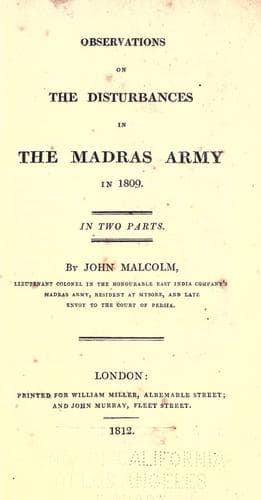
Observations on the Disturbances in the Madras Army in 1809Malcolm, John
History
Observations on the Disturbances in the Madras Army in 1809
Malcolm, John
India. Army -- History; Malcolm, John, 1769-1833
I may ask, Whether the order I suggested in my letter of the 5th of
July justifies the assertion in the letter from the Madras Government,
that I recommended "the restoration to the service and their
appointments of all the officers the Government had removed." The terms
of the order I suggested were only, that _in the full confidence_ that
the officers of the coast would immediately abandon their proceedings,
Government would _recommend_ the _officers suspended to the Court of
Directors_. That it restored Colonels Bell and Chalmers to command,
from which they had been removed, and also one or two staff officers
who were in a similar predicament. There is assuredly a wide difference
between the immediate restoration of all the officers suspended from
the service, and the conditional promise of a favourable recommendation
to that authority by which, under every circumstance, the fate of
these officers must have been decided. With respect to Colonel Bell,
I conscientiously believed at the moment, from what I knew of the
case of that valuable officer, that Sir George Barlow would not be
reluctant to consent to his restoration; and with regard to that of
Colonel Chalmers and one or two others in nearly similar predicaments,
I conceived that if any measure of this kind was adopted, it should
be as complete as it was possible to make it, without affecting the
principle which was to carry _conciliation in act_ (words, after what
had passed, could be of little or no avail) as far as was possible,
without serious injury to the authority and dignity of Government.
It was this consideration which led to the communication already
quoted from my letter of the 6th of July regarding the first Memorial
forwarded by General McDowall. What I recommended was nothing more
than what had, I believe, been done as an act of course, and was
stated in a mode which, though conciliatory, reminded the army of
their duty, and gave them no reason to believe more, than that the
Court of Directors _would see_ the document in question. I think at
this moment, as I did at that in which I recommended this measure,
that nothing could have been more fortunate than its adoption. I know
I differ on this point from very high authorities, who believe that
any concessions, (and such they would appear to deem _every act_ of
conciliation,) however modified and corrected, would have been ruinous
to Government: but, in spite of these imposing opinions[59], I must
ask reflecting men to look near the subject, to examine the evil which
this measure could have produced, consider the ills that were at that
moment to be expected, and to think on those that have resulted from
the complete success to authority that the most sanguine could have
anticipated, and then to pronounce their cool and deliberate judgment.
There certainly could be no apprehension entertained that this order
would have strengthened, to any purpose of immediate violence or
Public-domain text, read in full here on John Shaqi.
Reviews
Reviews
No reviews yet
Be the first to share your thoughts on this work.
Elsewhere in the archive
Join the Discussion
Join the discussion
Sign in to leave a comment or review.
Sign InorCreate an account