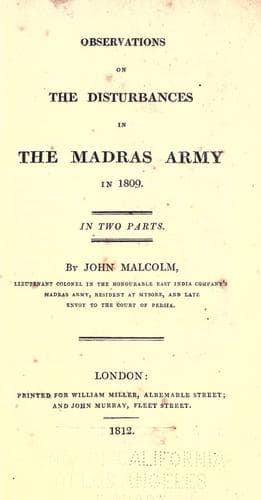
Observations on the Disturbances in the Madras Army in 1809Malcolm, John
History
Observations on the Disturbances in the Madras Army in 1809
Malcolm, John
India. Army -- History; Malcolm, John, 1769-1833
affinity; and I was (I must confess it,) wrong in supposing, for a
moment, that my advice, or any arguments I could adduce, could, under
any circumstances, permanently divert the Governor of Fort St. George
into a course that mixed feeling, and consideration for human failings,
with the established maxims of his ordinary rule. I should have known
better; and in fact I did, as my letters[68] before I went to Madras
prove: but, when on the spot, my heart conquered my head, and I tried
an impossibility: but I never shall regret the attempt, nor blush for
having recommended principles of action that are congenial to the best
feelings of human nature, that are calculated to make Government an
object of rational attachment, and to give the mind a generous pride
in submission and obedience; and which, so far from being of dangerous
example, and subversive of order, are familiar in the practice to every
free state, and have never been rejected in the most despotic, when
such have been governed by great and wise rules.
FOOTNOTES:
[40] These were the persons who fabricated those reports that were
circulated and believed by numbers, respecting promises of aid and
support from the officers of Bengal and Bombay.
[41] _This fear of being thought afraid_, is, perhaps, of all motives
of human action one of the weakest, though it wears a mask of boldness,
and under that is often productive of infinite mischief.
[42] I thought so at that period, though I have been since convinced I
was mistaken.
[43] Sir George Barlow not only thought so, but must, from the Governor
General's letter to the secret committee of the 12th of October
1809, have conveyed the same impression to Lord Minto. The merit of
foresight will not assuredly be claimed as one among the talents that
were displayed by the Governor of Fort St. George upon this memorable
occasion.
[44] See Lieutenant-Colonel Malcolm's letter to General Gowdie, in the
Appendix.
[45] Lieutenant Maitland, the dismissed quarter-master, was ordered
to command the marines; and Lieutenant Forbes, who had been banished
to Condapilly, was directed to proceed to relieve an officer of the
regiment on duty at Prince of Wales's Island. This second punishment
was a torturing revival of those wrongs, of which not only the parties,
but all the officers of the corps, had before, with some justice,
complained.
[46] Lieutenant-Colonel Barclay afterwards returned me the original
note.
Public-domain text, read in full here on John Shaqi.
Reviews
Reviews
No reviews yet
Be the first to share your thoughts on this work.
Elsewhere in the archive
Join the Discussion
Join the discussion
Sign in to leave a comment or review.
Sign InorCreate an account