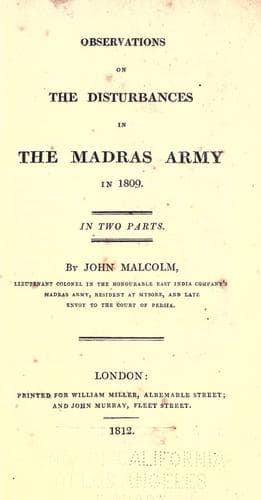
Observations on the Disturbances in the Madras Army in 1809Malcolm, John
History
Observations on the Disturbances in the Madras Army in 1809
Malcolm, John
India. Army -- History; Malcolm, John, 1769-1833
[59] I always thought, and always must think, that there is a wide
difference between the seditious combination of a body of officers
and a mutiny of soldiers, and that the two cases require a distinct
treatment. With the latter there can hardly be two modes of proceeding;
with the former there may be various, and all equally safe. They may
be restored by the influence of reason, and subdued by the operation
of their own feelings. Their minds may be reclaimed by many modes that
could not be applied to their men; and there is, in the worst extremes,
a character in their opposition that admits more of the application
of such remedies than the mad and instinctive action of a mutinous
soldiery. These two cases were certainly confounded at Madras; and most
of the evils that arose may be imputed to the fallacy of treating a
seditious combination of officers as a mutiny of soldiers.
[60] The danger that had been incurred was sufficient to authorize
Government to take the most decisive measures to guard against the
revival of such combinations against authority: and though numbers who
might have merited punishment had escaped, _not one object of benefit
to either individuals or the army at large had been attained_; and it
is therefore quite extravagant to assert such a termination could ever
have tended to encourage future proceedings of a similar nature.
[61] The account of what occurred at this station on the day General
Close made the noble effort he did to carry the orders of the
Government of Madras into execution, shows the desperate hazard that
was incurred. If, says an officer of high rank, during the period that
between four and five thousand troops were in a state of mutinous
violence and uproar, "one musket had gone off by accident, not a man of
his Majesty's 33d regiment would have been left alive, and a general
massacre of almost all Europeans would have been the most certain
result."
[62] No consideration of this question can be local or limited. If a
successful example of disobedience or rebellion was exhibited by our
native troops on the Madras establishment, its baneful effects would
not be limited to that part of our possessions.
[63] I spoke to Colonel Barclay before I wrote upon this subject,
and he said he would show my note to Sir G. Barlow, and obtain me an
answer that would vindicate my character from the charge to which the
Governor's change of resolution had made me liable. This circumstance
left me without a doubt that the cautious reply I received from that
officer was by the direction of Sir G. Barlow. Indeed, I was satisfied
that this excellent and respectable officer, for whom I have always
entertained the same sentiments of esteem and friendship, never acted
in any part of those transactions, in which his name appears, _but by
the specific instructions or orders the Governor_.
[64] Post.
[65] See a copy of this in the Appendix.
[66] The officers of that force had signed the test.
Public-domain text, read in full here on John Shaqi.
Reviews
Reviews
No reviews yet
Be the first to share your thoughts on this work.
Elsewhere in the archive
Join the Discussion
Join the discussion
Sign in to leave a comment or review.
Sign InorCreate an account