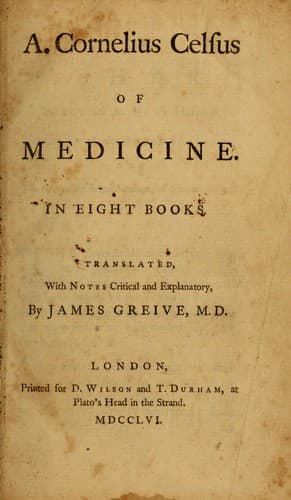
Of Medicine, in Eight BooksCelsus, Aulus Cornelius
History
Of Medicine, in Eight Books
Celsus, Aulus Cornelius
Medicine, Greek and Roman
Generally the ancients kept such patients in the dark; for this reason,
that it hurts them to be terrified: and they judged, that darkness of
itself contributed something to the quiet of the mind. But Asclepiades,
alleging that darkness itself strikes terror, ordered them to be kept
in the light. But neither of these holds always. For one person is
more disturbed by the light, and another by darkness: and some are to
be met with, in whom no difference can be found either the one way or
the other. Therefore it is best to try both methods; and to keep him,
that has a horror at darkness, in the light; and him, that is afraid
of light, in darkness. But where there is no such difference, if the
patient have strength, he must be confined in a light place; if not, in
a dark one.
To make use of remedies in the greatest violence of the phrenzy is
needless: for at the same time the fever also increases. Wherefore
nothing is to be done then, besides confining the patient. But when
the circumstances allow, speedy help must be administered. Asclepiades
asserted, that to bleed such was just the same as to murder them: upon
this principle, that there was no madness, but when the fever was very
high; and that bleeding could not be properly performed, unless in
its remission. He himself endeavoured to procure sleep in such cases
by much friction. But since both the violence of the fever prevents
sleep, and friction is not useful unless in its remission, he ought to
have omitted this remedy too. What then is to be said to this case?
Many things are properly done in imminent danger, which should not be
practised on any other occasion. And even a continued fever has times,
in which, though it does not remit, nevertheless it does not increase.
And this though not the best, yet is a pretty favourable season for the
application of remedies. And if the strength of the patient admits of
it, he may also lose blood.
There may be the same reason(16) for doubting whether a clyster
should be administered. Then after the interval of a day, it is fit to
clip the hair of the head close to the skin; then to foment it with
a decoction of some of the restringent herbs; or to foment it first,
after that clip, and foment it again; and lastly to embrocate the
head and nostrils with oil of roses; to hold also to the nostrils rue
bruised with vinegar, and to provoke sneezing by medicines efficacious
for that purpose. These things however are to be done only to persons,
who don’t want strength. If there be a weakness, the head is only to
be moistened with oil of roses, adding to it serpyllum or something of
the like nature. Also whatever be the degree of strength, two herbs are
useful, nightshade and the wall-herb, if the head be bathed with the
expressed juice of them both. When the fever has remitted, friction
must be used; but more sparingly in those, that are too merry, than in
those, that are too sad.
Public-domain text, read in full here on John Shaqi.
Reviews
Reviews
No reviews yet
Be the first to share your thoughts on this work.
Elsewhere in the archive
Join the Discussion
Join the discussion
Sign in to leave a comment or review.
Sign InorCreate an account