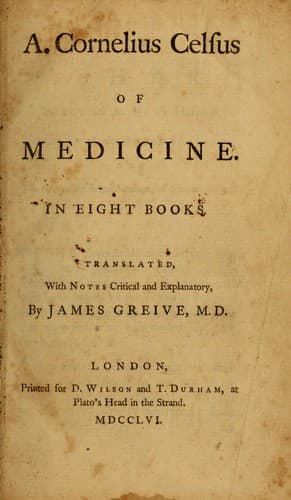
Of Medicine, in Eight BooksCelsus, Aulus Cornelius
History
Of Medicine, in Eight Books
Celsus, Aulus Cornelius
Medicine, Greek and Roman
If the abscess be forming in any of the nobler parts, the accession
of matter there must be prevented by cataplasms, which are at the
same time repellent and cooling; such as I have mentioned under the
erysipelas and elsewhere. If it is grown pretty hard, we must have
recourse to discutients and resolvents; such as a dry fig bruised, or
lees of wine mixed with cerate, made up with hog’s lard; or the root of
wild cucumber, with the addition of two parts of meal, first boiled in
mulse. We may also mix equal parts of ammoniacum, galbanum, propolis,
viscum, adding of myrrh not half the quantity of any of the other
ingredients: and the plaisters and malagmas I have mentioned before,
have the same effect.
What is not discussed by these, must necessarily maturate. And to
hasten this, must be applied barley meal mixed with water; to which
also it will be proper to add some herbs. The same applications(87)
are fit for the lesser abscesses too, whose names and properties I have
recited above. The general method of cure is the same in them all; and
only differs in the degree. Now that tumour is crude, in which there
appears a strong pulsation of the arteries, a weight, heat, tension,
pain, redness, and hardness; and if the abscess be large, a shuddering,
as also a slight fever continues; and the suppuration being pretty deep
and concealed, instead of the marks, which otherwise shew themselves
in the skin, there are prickings. When these have abated, and the part
begins to itch, and either becomes somewhat livid or whitish, the
suppuration, is perfected. And when it either breaks of itself, or is
opened by medicines, or by incision, the pus ought to be discharged.
And if it happens in the armpits or groin, it must be dressed without
lint. In other parts too, if it is narrow at the bottom, if the
suppuration has been moderate, if it has not penetrated deep, if there
is no fever, if the patient be strong, lint is equally needless. In
other circumstances it ought to be used, sparingly however, and not
unless the wound be large. It does well to spread honey upon the lint;
or without it, to apply lentils with honey, or pomegranate bark boiled
with wine. And these things are proper both alone and mixed.
If any parts round it should be too hard, to soften them may be applied
either mallows beat, or fenugreek, or lintseed boiled in passum. And
then whatever is to be applied, ought to be secured not by a tight,
but an easy bandage. Every body ought to know, that in this kind of
disorder cerate may be used. What else belongs to the cleansing of the
ulcer, filling it up, and bringing on a cicatrix, and equally relates
to wounds, has been already pointed out.
[Sidenote: _Of fistulas._]
Public-domain text, read in full here on John Shaqi.
Reviews
Reviews
No reviews yet
Be the first to share your thoughts on this work.
Elsewhere in the archive
Join the Discussion
Join the discussion
Sign in to leave a comment or review.
Sign InorCreate an account