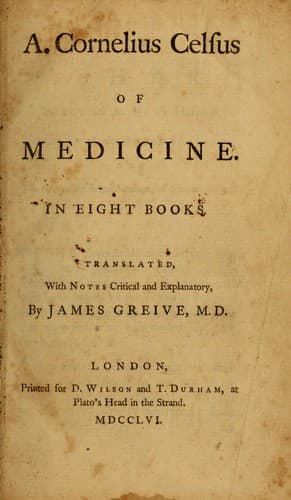
Of Medicine, in Eight BooksCelsus, Aulus Cornelius
History
Of Medicine, in Eight Books
Celsus, Aulus Cornelius
Medicine, Greek and Roman
contact with clean flesh can fail to unite, especially when medicines
proper for that purpose are made use of; since often an ulceration of
the fingers, unless great care is taken to prevent it, will join them
together in the healing.
[Sidenote: _Of the cerion ulcer._]
There is also a kind of ulcer, which from its resemblance to a
honeycomb, by the Greeks is called cerium[FE]. And of this there are
two species: the one is of a whitish colour, and like to a furuncle,
but larger, and attended with great pain. When it maturates, it has
openings, through which is discharged a glutinous and purulent matter;
nevertheless it does not come to a due ripeness. If it be divided by
incision, there appears to be a great deal more corruption within, than
in a furuncle, and it reaches deeper. It seldom occurs but amongst the
hair of the head.
[FE] κηρίον.
The other is less, and eminent upon the top of the head, hard, broad,
of a pale green colour, and more ulcerated; for there are openings
at the roots of each of the hairs, through which issues a glutinous,
palish humour, in consistence like honey, or viscum, or sometimes oil;
and if an incision be made upon it, the flesh within appears green.
There is a great pain and inflammation, insomuch that they often bring
on an acute fever.
To that kind, which has fewer openings, it is proper to apply dry figs,
and lintseed boiled in mulse, and drawing plaisters and malagmas, or
the medicines, of that quality above recited.
Upon the other, the same medicines, likewise meal boiled in mulse, and
half the quantity of turpentine resin added to it; and a fig boiled in
mulse; to which a little powdered hyssop is added; likewise a fourth
part of stavesacre added to the fig. But if medicines do but little
service in either kind, the whole ulcer must be cut out to the sound
flesh. When the ulcer is taken away, medicines must be applied over the
wound; first such as promote pus, next detergents, then such as incarn.
[Sidenote: _Of the acrochordon, acrothymium, myrmecia, and the clavus._]
There are also some resembling warts, which have different names, as
they are different disorders. The Greeks call that an acrochordon[FF],
where a substance pretty hard is collected within the skin, which
sometimes is rough, and of the same colour with the adjacent parts;
near the skin it is narrow, and broader above. This is small, rarely
exceeding the size of a bean. They are hardly found to grow single;
generally a number together, and chiefly in children. They sometimes
suddenly disappear, sometimes they excite a moderate inflammation. Some
are also converted into pus.
[FF] ἀκροχορδὼν.
Public-domain text, read in full here on John Shaqi.
Reviews
Reviews
No reviews yet
Be the first to share your thoughts on this work.
Elsewhere in the archive
Join the Discussion
Join the discussion
Sign in to leave a comment or review.
Sign InorCreate an account