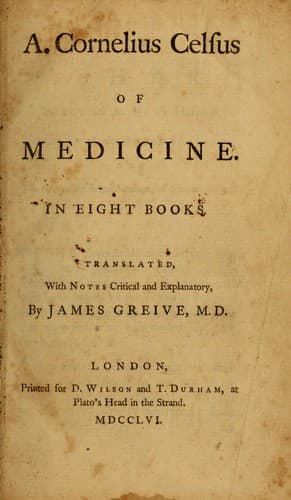
Of Medicine, in Eight BooksCelsus, Aulus Cornelius
History
Of Medicine, in Eight Books
Celsus, Aulus Cornelius
Medicine, Greek and Roman
There is no bone within the skin of the belly; but fistulas in that
part are extremely dangerous; insomuch that Sostratus believed them
incurable. That they are not always so, experience has shewn. And
indeed, which may seem very wonderful, a fistula opposite to the
liver and spleen, and stomach, is more safe than one opposite to the
intestines: not that the thing is of its own nature more pernicious
there, but because it exposes to a danger of another kind. The reason
of which fact some authors have but little understood, though their
experience convinced them of this difficulty. For the belly itself is
often wounded by a weapon, and the intestines, that have fallen out,
are replaced, and the wound united by sutures: the manner of doing
which I shall point out presently. Therefore, when a small fistula
has even penetrated the abdomen, it may be cut out, and the lips of
it joined by a suture. But if the fistula spreads wider within, upon
its being cut out, it must necessarily leave a pretty large vacuity,
which cannot be sewed up without great violence; especially on the
internal side, where there is a kind of membrane, which the Greeks call
peritonaeum, that surrounds the abdomen. Therefore, as soon as a person
begins to walk or move, the suture breaks, and the intestines are let
loose, so that the patient must perish. But the case is not always
desperate; and therefore, we must attempt the cure of smaller fistulas
there.
[Sidenote: _Of fistulas in the anus._]
Fistulas in the anus require a particular treatment. A probe being
put into them, an incision must be made in the skin at its further
end: then the probe must be drawn out at the new orifice with a thread
following it, which was put through an eye made in the other end for
the purpose. There the thread must be taken hold of, and tied to the
other end, that it may gently take hold of the skin above the fistula:
and the thread should be made of crude lint(6), double or triple,
and so twisted as to make one string. In the mean time the patient
may go about his business, walk, bathe, and eat, just as if he were
in the most perfect health. Only loosing this knot(7) twice a day,
the string must be drawn in such a manner, that the part, which was
above, may then be within the fistula. And the thread must not be
suffered to rot, but every third day, the knot must be untied, and at
its one end must be fixed a fresh ligature, which when the old one is
drawn out, must be left in the fistula with a like knot. For thus it
gradually cuts the skin that is above the fistula: and, at the same
time, the part that has been eat through by the thread, heals; whilst
the remainder, which is pinched by the thread, continues to be cut by
it. This method of cure is long, but is attended with no pain.
Public-domain text, read in full here on John Shaqi.
Reviews
Reviews
No reviews yet
Be the first to share your thoughts on this work.
Elsewhere in the archive
Join the Discussion
Join the discussion
Sign in to leave a comment or review.
Sign InorCreate an account