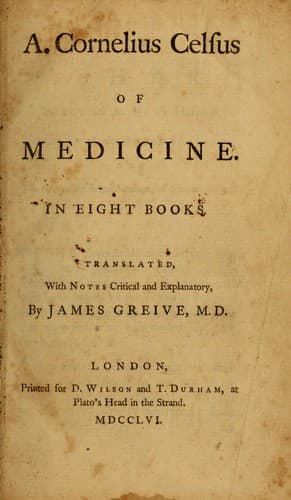
Of Medicine, in Eight BooksCelsus, Aulus Cornelius
History
Of Medicine, in Eight Books
Celsus, Aulus Cornelius
Medicine, Greek and Roman
The foregoing directions are general: besides which, there are some
particular rules for the several kinds of weapons, which I shall
immediately subjoin. Nothing is so easily lodged in the body as an
arrow, and it goes to the greatest depth. The reasons are, both that it
moves with great force, and because it is small. Therefore, it must be
extracted more frequently on the opposite part, than on that by which
it entered, and especially because it is generally surrounded with
beards, which lacerate more, if they be drawn backward than forward.
But an orifice being made on the opposite part, the flesh ought to
be opened by an instrument made in the form of the Greek letter ν;
and when the point appears, if the shaft adheres to it, it must be
pushed forward, till it can be taken hold of at the opposite part, and
extracted. If that is already broke off, and only the iron head is
within, the point must be taken hold of by the fingers, or a forceps,
and thus pulled out. And there is no other method of extracting it,
when it is thought adviseable to pull it out by the orifice it entered
at: for after the wound is enlarged, either the shaft, if that be
lodged within, must be pulled out; or if that be not there, the iron
itself. But if the beards are visible, and they are short and small,
they ought to be broke off with a forceps, and the weapon, when freed
of them, to be brought out; if they are larger and stronger, they must
be covered with writing reeds split, to prevent their lacerating any
part, and thus pulled out. This is the method observed in extracting
arrows.
[Sidenote: _Of broad weapons._]
But if a person has a broad weapon lodged within his flesh, it is not
proper to draw it out at the opposite part, lest we add another great
wound to the large one already made. It must therefore be pulled out
with a certain kind of iron instrument, which the Greeks call the
graphiscus of Diocles[GP], because it was invented by Diocles, whom I
have already taken notice of among the ancient and greatest physicians.
This is a plate of iron, or sometimes of copper, at the one end,
having two claws turned downwards on each side; the other perforated
and folded back on each side; bent a little at that extremity, which
has the claws; and likewise on the other, which is perforated. This
is introduced transversely, hard by the weapon; and then, when it
has reached its point, it is turned a little, that it may receive
the weapon into the perforation. When the point is in the hole, the
operator, clapping two of his fingers to the claws at the other end,
draws out at once his instrument and the weapon.
[GP] γραφίσκος Διοκλέους.
[Sidenote: _Of leaden bullets, &c._]
A third kind of weapon, which requires sometimes to be pulled out, is
a leaden bullet, or a stone, or some such thing, which having broke
through the skin, is entirely lodged within. In all these cases, the
wound must be enlarged, and what is within must be extracted by a
forceps the way it entered.
Public-domain text, read in full here on John Shaqi.
Reviews
Reviews
No reviews yet
Be the first to share your thoughts on this work.
Elsewhere in the archive
Join the Discussion
Join the discussion
Sign in to leave a comment or review.
Sign InorCreate an account