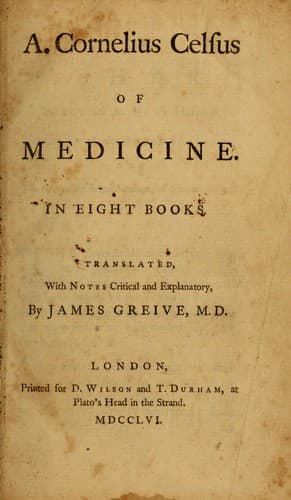
Of Medicine, in Eight BooksCelsus, Aulus Cornelius
History
Of Medicine, in Eight Books
Celsus, Aulus Cornelius
Medicine, Greek and Roman
is, that all the liquor at that time descends, not into the bladder,
but into the intestines) if the mouth is ulcerated; if the face is red,
and marked with certain spots of all colours; if the belly is puffed
up as it were by fermentation(16), fat and full of wrinkles; and if
there is no appetite for food. And as in these circumstances death is
the plain consequence; it is much more evidently so, if the disease
is already of long standing; especially if withal the patient be old.
In the distemper of the smaller intestine, a vomiting, hiccough,
convulsion, and delirium, are bad symptoms. In the jaundice it is the
most pernicious symptom for the liver to be indurated. Those, that have
disorders in the spleen, if they be seized with a dysentery, which
afterwards turns to a dropsy or a lientery, it is scarce in the power
of medicine to save. The distemper of the smaller intestine arising
from a difficulty of urine, unless it be removed by a fever, kills
within seven days. If a woman after delivery is seized with a fever,
and violent and constant pains of the head, she is in danger of dying.
If there is a pain and inflammation in those parts, which contain the
bowels, it is a bad sign to fetch the breath often. If a pain of the
head continues long without a perceptible cause, and removes into the
neck and shoulders, and again returns into the head; or comes from the
head to the neck and shoulders, it is dangerous: unless it produce
some vomica, so that the pus may be expectorated; or unless there is
an hæmorrhage from some part; or scurf break out plentifully in the
head, or pustules over the whole body. It is an equally formidable
distemper when a numbness and itching wander about; sometimes over the
whole head, sometimes in a part of it; or when there is something like
a sensation of cold in the part, and these reach even to the end of
the tongue. And though in these cases abscesses are beneficial, yet
there is less hope of a recovery by their means, as they are seldom
formed after such disorders begin. In pains of the hip, if there is
a great numbness, and the leg and hip are cold, and the belly has no
passage, but when assisted, and the excrements are slimy, and the age
of the person exceed forty, the distemper will be very tedious, and at
least of a year’s continuance; neither will it be possible to remove
it, unless it be either in the spring or autumn. At the same time of
life, the cure is equally difficult, when a pain of the arms removes
into the hands, or reaches to the shoulders, and produces a torpor and
pain, and is not relieved by a bilious vomiting. A paralytic limb in
any part of the body, if it has no motion, and pines away, will not
recover its former state; and the more inveterate the distemper, and
the more advanced in years the patient is, so much the less probable
is the cure. And in every paralytic disorder, the winter and autumn are
improper seasons for medicine: some benefit may possibly be hoped for
Public-domain text, read in full here on John Shaqi.
Reviews
Reviews
No reviews yet
Be the first to share your thoughts on this work.
Elsewhere in the archive
Join the Discussion
Join the discussion
Sign in to leave a comment or review.
Sign InorCreate an account