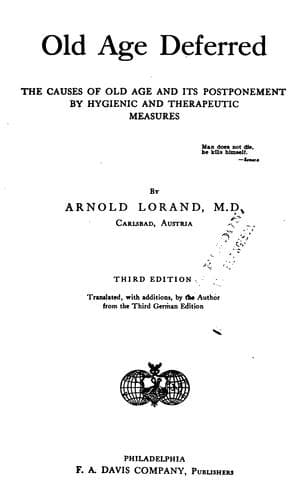
Old Age Deferred: The causes of old age and its postponement by hygienic and therapeutic measuresLorand, Arnold
Science
Old Age Deferred: The causes of old age and its postponement by hygienic and therapeutic measures
Lorand, Arnold
Hygiene; Longevity; Old age
Yvette Guilbert, in her novel the “Demi-vieilles,”[162] describes in a
picturesque manner the pangs of a woman at the climacteric age. Let us
quote a few lines: “They try to remain young, hide the gradual onset of
their ugliness, and look for a chance to taste of love again. They cry
out for the past, for even while they fight against time they cannot
detain it in its course.” This description, however, does not apply only
to the majority of middle-aged women, but more especially to
professional beauties.
Footnote 162:
Quoted after Professor Kisch.
It can be seen from these considerations how necessary it is for a woman
who has frequent pregnancies to observe the rules of hygiene. That these
produce excellent results we have proved. We know of a score of ladies
of the aristocratic and wealthy classes who, though having six or even
seven children, look none the worse. A certain Austrian archduchess
still remains a beautiful woman, in spite of her eight children and the
fact that she is a grandmother. Such examples may be frequent in old
families with this hereditary tendency. Though the bearing of many
children can hasten old age, yet, on the other hand some women, after
the birth of their first child, become better and fresher looking. We
can see this especially in girls of twenty or more who, having appeared
somewhat withered before marriage, begin to bloom afresh after the birth
of the first child. Increased activity of the ovaries and thyroid is the
explanation of this phenomenon. As already mentioned, the thyroid takes
an active part in ovarian changes. In a young girl of fourteen, just
previous to menstruation and puberty, we may find a swelling of the
thyroid gland. During menstruation we can often see a distinct
enlargement of the thyroid, and at the same time certain nervous
symptoms such as are usually connected with thyroid change.
Increased activity of the thyroid during pregnancy is shown by a
swelling of the gland, often causing a regular goiter, and, at the same
time, not infrequently by the typical symptoms of exophthalmic goiter.
Lactation is also dependent upon thyroid activity. After prolonged
lactation there is an exhaustion of thyroid activity; and, on the other
hand, by giving thyroid extract we can increase the flow of milk.
The swelling of the thyroid in the above conditions can be explained by
the greater demand for thyroid secretion, and that this hyperactivity
occurs is also shown by the observations of the early writers on
myxœdema. Morvan, Ord, and Combe found that myxœdema was frequently
caused by numerous pregnancies, especially if associated with prolonged
lactation.
Public-domain text, read in full here on John Shaqi.
Reviews
Reviews
No reviews yet
Be the first to share your thoughts on this work.
Elsewhere in the archive
Join the Discussion
Join the discussion
Sign in to leave a comment or review.
Sign InorCreate an account