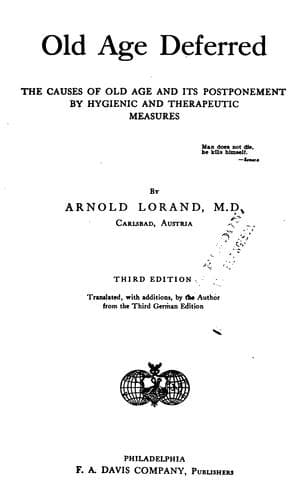
Old Age Deferred: The causes of old age and its postponement by hygienic and therapeutic measuresLorand, Arnold
Science
Old Age Deferred: The causes of old age and its postponement by hygienic and therapeutic measures
Lorand, Arnold
Hygiene; Longevity; Old age
We frequently notice that persons who have not slept well for several
nights, especially if passed on a railway journey, look worn out and
older. After a good night’s rest these effects disappear and they look
fresh and younger again.
There are other functional disturbances which are especially harmful as
they interfere with the elimination of harmful products either
introduced with the food or found in the body (e.g., uric acid). This
applies also to the bowels, perspiration, and diuresis. When these
important functions are checked, there is retention of poisonous
products and a condition of auto-intoxication. These functions are
governed by the ductless glands, especially the thyroid, as we have seen
in Chapter VI. It is easy to understand that by their interruption the
onset of old age is hastened, as these toxins will cause deterioration
and destruction of epithelium and the formation of connective tissue in
its place. Retained poisonous products play a very great etiological
rôle in the production of arteriosclerosis, which is found as a typical
symptom of old age in the large majority of aged persons.
We thus see that all those agencies which by common consent are usually
considered the most frequent causes of old age, are also very
detrimental to the ductless glands, especially the thyroid. They produce
hyperactivity, with subsequent exhaustion, in these important glands.
The pathological and anatomical changes indicating hyperactivity give
place to those of atrophy. We have given an example of this in
discussing the changes in the thyroid in infectious diseases. The
formation of connective tissue is the final result. Thus a condition of
the thyroid arises similar to that in myxœdema, which, as we have
stated, can be produced by causes similar to those which produce old
age—i.e., infectious diseases, exhaustion of the ovaries after
pregnancies or sexual excesses, mental emotions, etc.
The pathological and anatomical changes in the thyroid, consisting of an
increase in the connective tissue, as in myxœdema, will logically
produce clinical symptoms, and these symptoms are the same as those of
myxœdema.
Therefore we are justified in assuming that old age will show the same
clinical symptoms as myxœdema.
We have shown that, given changes in the thyroid gland, the other
ductless glands will be altered too; for instance, the liver and
kidneys. These glands have an important function in freeing the organism
of poisonous substances. As in old age their secreting elements are more
or less atrophied, they are unable to execute their task properly, and
these harmful products will accumulate. Now, there are important organs
which can act as corollaries to these glands. These are the intestines
and the skin. They also are under the influence of the thyroid. In
diseased conditions of the thyroid they are unable to perform their
functions regularly. The poisons will not be eliminated, and thus a
condition of auto-intoxication must arise.
Public-domain text, read in full here on John Shaqi.
Reviews
Reviews
No reviews yet
Be the first to share your thoughts on this work.
Elsewhere in the archive
Join the Discussion
Join the discussion
Sign in to leave a comment or review.
Sign InorCreate an account