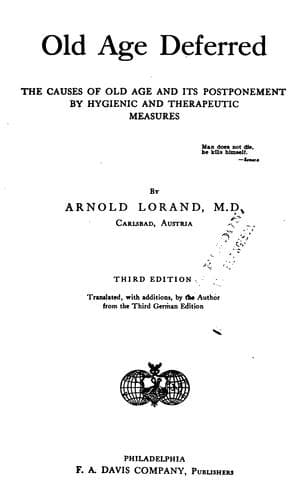
Old Age Deferred: The causes of old age and its postponement by hygienic and therapeutic measuresLorand, Arnold
Science
Old Age Deferred: The causes of old age and its postponement by hygienic and therapeutic measures
Lorand, Arnold
Hygiene; Longevity; Old age
Not only for the infant in arms, but for the growing baby and child
during its first year, milk food, containing largely of milk and
cereals, will be the best diet, excluding meat entirely, since in these
tender years the ductless glands are not sufficiently developed to
destroy poisonous products that arise from the end-products of
decomposition of meat. By giving these little creatures meat we may
depreciate the efficiency of their ductless glands through unnecessary
strain in the destruction of poisons, and thus diminish their chances in
later life, of a prolongation of youth and a happy old age. For the same
reasons and even more weighty ones, alcohol, coffee, tea, etc., should
be avoided.
It is sad to reflect that, in some countries, alcohol is given to
children, who are even far more helpless against it than adults.
We have observed in Northern Hungary that the children of the Slovacks,
a Slav nation that inhabits certain parts of Hungary—the native land of
the writer,—are stunted in their growth. The reason for this is, that in
these parts of Hungary, where there are plenty of potatoes, but a
scarcity of other food, the peasants give brandy to their youngsters. As
we have seen in the second chapter of this book, the growth of the human
body depends on the thyroid gland. The fact that these children do not
grow shows that alcohol is deleterious to the thyroid. This question
will be considered more fully in the chapter on alcohol. The advantages
of milk food we shall also treat more fully in a separate chapter.
To deal with old age rationally, we must begin in childhood to fight
against it, as all those agencies that tend to produce it prematurely
can at this age prove far more deleterious; and as in this world no
action is lost—whether for good or evil—we must reap the results of our
imprudence in later life.
Unhappily at this tender age we have no reasoning powers, the glands
governing them not having been developed, and therefore our parents or
guardians must act for us. Their want must also be supplied by the
teacher, and we believe it would be productive of great good to teach
the elementary rules of hygiene in school at the same time as reading
and writing.
The impressions we first get in childhood remain throughout life and are
never forgotten; therefore, hygiene should be learned even by small
children. The soul of a child is like plaster of Paris, that can, like
dough, be moulded into any shape we desire. It is at this early age that
we should learn of the necessity of a bath every day, of moderation in
food, the avoidance of certain stimulants, such as alcohol, and also of
tea and coffee in large quantities.
Public-domain text, read in full here on John Shaqi.
Reviews
Reviews
No reviews yet
Be the first to share your thoughts on this work.
Elsewhere in the archive
Join the Discussion
Join the discussion
Sign in to leave a comment or review.
Sign InorCreate an account