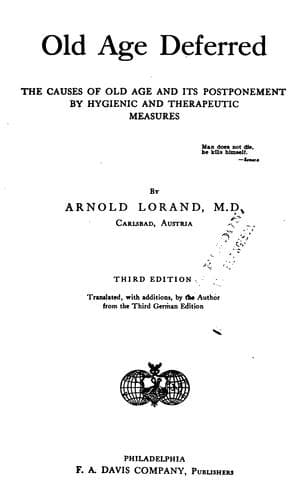
Old Age Deferred: The causes of old age and its postponement by hygienic and therapeutic measuresLorand, Arnold
Science
Old Age Deferred: The causes of old age and its postponement by hygienic and therapeutic measures
Lorand, Arnold
Hygiene; Longevity; Old age
The lymphatic glands play an important rôle, not only as the birthplace
of leucocytes, but also in that they are able to arrest noxious
substances, such as microbes, and keep them from entering the
circulation. That the lymphatic structures are able to protect us
against bacillary infection can be shown by the swelling of the spleen
in infectious diseases,—such as typhoid fever, malaria, etc.
The tonsils are also of some importance for our protection against
harmful substances. They become inflamed in various infectious
diseases—such as scarlet fever, measles, acute nephritis, etc. Their
great value may best be shown by the fact that not infrequently, after
total extirpation of both tonsils, a generalized eruption has been
observed. Thus we must always seriously reflect before advising the
extirpation of these important organs, the rôle of which as sentinels is
shown by their anatomical position on either side of the entrance for
the most indispensable elements of our life: air and food. Unless
frequent inflammation, and possibly irritative nephritis, demand an
operation, it would be better not to undertake it. Even if it is done,
the glands should never be entirely removed.
A great number of microbes enter our system through the mouth with the
air and food, but happily they are antagonized by the saliva and the
gastric juice, which are able to destroy a large number of these
obnoxious invaders. Like the ductless glands, the lymphatic glands are
closely connected with one another, and thus changes in one of these
glands are apt to be followed by changes in the others. Hence we can see
how a lymphatic structure contained in the intestine,—the appendix,—can
often become inflamed after previous inflammation of the tonsils. As is
well known, the appendix shows great similarity in its histological
structure to the tonsils, so much so that some call it an intestinal
tonsil. Several authors have drawn attention to the fact that
appendicitis has often been observed after tonsillitis, and Delcour has
written a monograph in which he attributes appendicitis, indirectly, to
thyroid degeneration,—e.g., congenital myxœdema. Adenoid vegetations are
always accompanied by chronic pharyngitis and tonsillitis, which bring
about appendicitis. And since adenoid vegetations are an expression of
thyroid deficiency, Delcour attributes appendicitis to a deficient
thyroid. We are not prepared to accept Delcour’s statement, as there are
cases of adenoid vegetations without a deficient thyroid. However, as we
have personally observed, chronic nasal catarrh and tonsillitis are very
frequent in persons subject to appendicitis. The appendix is an
important lymphoid organ and, if possible, it should be preserved.
Public-domain text, read in full here on John Shaqi.
Reviews
Reviews
No reviews yet
Be the first to share your thoughts on this work.
Elsewhere in the archive
Join the Discussion
Join the discussion
Sign in to leave a comment or review.
Sign InorCreate an account