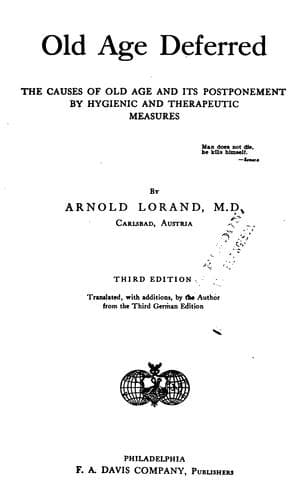
Old Age Deferred: The causes of old age and its postponement by hygienic and therapeutic measuresLorand, Arnold
Science
Old Age Deferred: The causes of old age and its postponement by hygienic and therapeutic measures
Lorand, Arnold
Hygiene; Longevity; Old age
In general, it is our opinion that to prevent disease in an organ the
surest method is to use those means through which that organ, when
diseased, is found to benefit. Of course this is only meant as a general
statement; but in the children of those suffering from liver complaints
such preventive treatment is particularly indicated, as these
conditions, we have found, are most frequently inherited. We have
treated cases where three or four generations of one family had been
sufferers from the same complaint.
Here, as always, let us follow the wise precept: “Prevention is better
than cure.”
------------------------------------------------------------------------
CHAPTER XV.
ON THE DESTRUCTION OF TOXIC PRODUCTS BY THE ADRENALS.
THERE is ample evidence in support of the contention that the adrenals
play an important part in the destruction of toxic products in the body.
As long ago as 1853, one of the leading authorities on the adrenals as
ductless glands, Brown-Séquard, noticed that the blood of animals
without adrenals was more toxic than that of animals the adrenals of
which had not been removed.
Langlois and Abelous[190] confirmed the conclusions of Brown-Séquard.
They also established the fact that the blood and muscular extracts of
frogs whose adrenals had been removed, were toxic, and contained a
poison of the nature of curare. The animals died from auto-intoxication,
and these savants came to the conclusion that the adrenals were created
to neutralize or destroy poisons which are evolved during muscular work.
Frogs from which the adrenals had been removed showed also lessened
resistance to muscular fatigue. Similar results have been observed by
Langlois in the case of other animals: rabbits, dogs, guinea-pigs, etc.
Albanese[191] also found that animals operated on as above exhibited
more fatigue than those whose adrenals had been allowed to remain
intact. The recent labors of Sajous which have shown conclusively that
the adrenals furnish to the blood one of its important immunizing
constituents explain all the above observations.
Footnote 190:
Abelous et Langlois: Archives de physiologic norm. et path., p. 267,
vol. iii, 1892, and “Travaux de Laboratoire,” Lancet, August 20, 1898;
Société de biologie, 1892.
Footnote 191:
Albanese: Archiv. Ital. di Biologia, p. 338, 1892.
The fact, observed by all these authorities, that when one of the
adrenals is removed the other becomes hypertrophied, sometimes to a
great extent, seems also to point to the conclusion that greater demands
are made on the gland that remains, the hypertrophied condition of which
appears to be due to the increased work required of it in protecting the
body from infection.
Public-domain text, read in full here on John Shaqi.
Reviews
Reviews
No reviews yet
Be the first to share your thoughts on this work.
Elsewhere in the archive
Join the Discussion
Join the discussion
Sign in to leave a comment or review.
Sign InorCreate an account