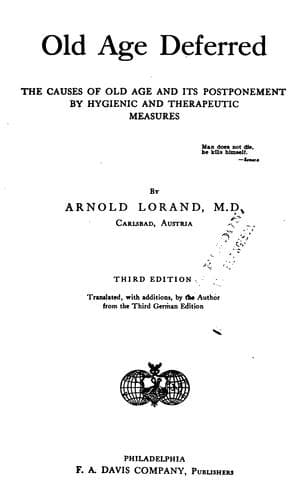
Old Age Deferred: The causes of old age and its postponement by hygienic and therapeutic measuresLorand, Arnold
Science
Old Age Deferred: The causes of old age and its postponement by hygienic and therapeutic measures
Lorand, Arnold
Hygiene; Longevity; Old age
We should like to add that, as the above agencies are also harmful to
the thyroid gland, the antagonist of the adrenals, its degeneration can
further the development of arteriosclerosis in the same way that
Eiselsberg produced an atheromatosis of the aorta in dogs after
extirpating the thyroid gland. According to Minnich, arteriosclerosis is
very common in people with goiter, appearing in them at a very early
age. Fries and Pineles found that alterations of the blood-vessels
occurred in goats after extirpation of their thyroid gland.
Since arteriosclerosis is so frequent in old age it must be due to the
degeneration of the thyroid and also to the aggregation of all the
above-named harmful agencies during a prolonged period. To avoid it, and
also premature old age, it is, therefore, most essential to guard
against all agencies harmful to the thyroid and adrenals, to which we
have referred above; and this is the best basis for the rational
treatment of arteriosclerosis. It is most fortunate that Dellamare
discovered in old age a hypertrophy of the adrenals.[208]
Footnote 208:
“Recherches sur la senescence des glandes surrénales,” Soc. biologie,
17 Oct., 1903.
All this is greatly strengthened by the recent investigations of Sajous,
which show that besides its action on the blood-pressure and the heart,
the adrenal secretion actually supplies the substance which in the
lungs, takes up the oxygen from the air to sustain life in all our
tissues. It thus becomes evident that harm to our adrenals is bound to
shorten life.
To recapitulate: There exist two chief agencies for the production of
arteriosclerosis: 1. A hyperactivity of the adrenals, causing a rise in
blood-pressure. 2. A degeneration of the thyroid gland, which, when
normal, antagonizes the first by lowering the blood-pressure. Although
from the above-mentioned facts high blood-pressure cannot be considered
as the chief cause of arteriosclerosis, still no doubt it certainly
contributes to it; for each time that there is a rise in the
blood-pressure more blood is forced through the arteries, thereby
causing them to dilate; and after a repeated number of such dilatations
the elasticity of the vessels will eventually be impaired, especially so
in the aged, where one part of the elastic fibers is already replaced by
connective tissue. As a result of the arteriosclerosis the passage of
blood through the capillaries will be impeded, and in consequence the
work of the heart will be increased; likewise the nutrition of the walls
of the vessels will be diminished. The best preventatives of
arteriosclerosis will therefore be: 1. To avoid all agencies which may
tend to cause excessive activity of the adrenals; and 2. To increase the
activity of the thyroid.
Public-domain text, read in full here on John Shaqi.
Reviews
Reviews
No reviews yet
Be the first to share your thoughts on this work.
Elsewhere in the archive
Join the Discussion
Join the discussion
Sign in to leave a comment or review.
Sign InorCreate an account