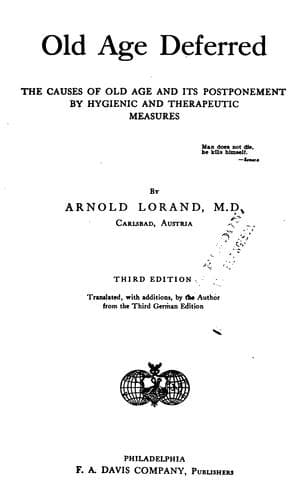
Old Age Deferred: The causes of old age and its postponement by hygienic and therapeutic measuresLorand, Arnold
Science
Old Age Deferred: The causes of old age and its postponement by hygienic and therapeutic measures
Lorand, Arnold
Hygiene; Longevity; Old age
Stagnation takes place in sluggish bowels. As a general rule, fæcal
movement is caused by peristalsis of the intestines, which consists of
circular contractions of the bowel by which the contents are propelled
toward the end of the same; besides these movements there are also
pendular or vermicular contractions of certain parts of the intestines;
all these movements also assist the admixture of the chyme with the
juices of the intestines. All these contractions are caused by impulses
from the nerves which lie in the walls of the intestines, the plexus
myentericus; they can also be provoked by impulses coming from the
central nervous system.
The nerve ganglia that lie in the walls of the intestines can be
influenced mechanically by the contents of the intestines, when such are
bulky, and also when they are fermenting; therefore, the bacteria, by
promoting fermentation, also aid in peristalsis. The bulky condition of
the bowel contents can be best induced by food of the vegetable kingdom
through its cellulose contents, of which tissue the cells of plants or
fruits are largely formed. When these irritating agents act on the nerve
filaments in the intestines, the bowel will contract and expel its
contents.
But when food contains no irritating substances and is easily
assimilated without forming _residues_, or when the innervation by the
vagus is sluggish and the peristaltic movements are slow, the contents
of the intestines can remain longer, especially in the haustra of the
intestines. It may be that the bowels move every day, but that does not
prove that everything in the intestines has been expelled therefrom, for
some amount of fæces can yet remain in the haustra of the intestine even
for many days; so that in such cases there is still a constipation of
one part of the bowels. We have observed, personally, and on patients,
that, after a good opening of the bowels, when a purge is given—for
instance, directly after a meal—a short time afterward there has been
another copious discharge that had evidently remained behind. Thus, no
doubt a retention of fæces, and sometimes a condition analogous to
auto-intoxication, can be caused in people who have the bowels opened
every day, although not to the extent of those having obstruction or
habitual constipation.
To avoid such a condition a good purge should be taken at regular
intervals, say once a week, even by persons who have a movement daily,
in order to eliminate matter which may have remained. It will not be
necessary, naturally, to use a too powerful purgative, but one adapted
to the necessity of the case; taking, as a rule, such a purge as will
act a little better than the ordinary bowel movement, and graduated
according to the strength of the person so using it.
Public-domain text, read in full here on John Shaqi.
Reviews
Reviews
No reviews yet
Be the first to share your thoughts on this work.
Elsewhere in the archive
Join the Discussion
Join the discussion
Sign in to leave a comment or review.
Sign InorCreate an account