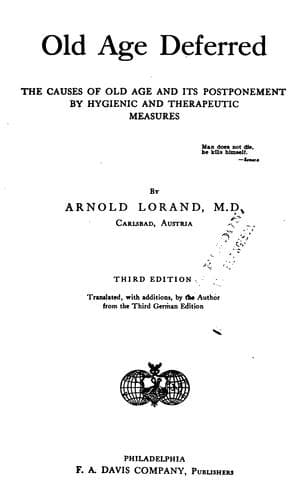
Old Age Deferred: The causes of old age and its postponement by hygienic and therapeutic measuresLorand, Arnold
Science
Old Age Deferred: The causes of old age and its postponement by hygienic and therapeutic measures
Lorand, Arnold
Hygiene; Longevity; Old age
The prevention of intestinal putrefaction is, however, equally important
in younger people. As Combe proves, we can avoid this by the use of
certain kinds of food, especially carbohydrates and fruit, and by other
substances producing lactic acid, which is, indeed, the best
disinfectant for the intestines. The great benefit of various kinds of
sour milk generally has been pointed out by Metschnikoff and his
disciples. Among the causes of old age this savant attributes an
important rôle to the processes of putrefaction in the intestines, and
to avoid this he recommends the use of a certain kind of sour milk
produced by fermentation by a number of microbes, including the
Bulgarian _Bacillus maya_.
That certain kinds of food exercise poisonous effects when introduced
into the intestines is a matter of common observation. Thus, in not a
few cases, fever, accompanied by cutaneous eruption, may be witnessed
after partaking of strawberries or oysters, and especially after eating
meats (notably sausages) which are in a state of decomposition. Severe
cases of poisoning, even resulting in death, have occurred; and in
Germany there have been, from time to time, regular epidemics after
partaking of sausages in the above condition.
Of course everyone partaking of such poisonous food will not become
poisoned as this is prevented by the action of such glands as the
thyroid and liver, whose function it is to preserve us from such
effects. People in possession of healthy sensory organs,—eyes, nose, and
tongue,—will be enabled to tell whether meat is in a fit condition to be
eaten or not; but frequently we cannot discover by our senses a state of
decomposition when such is not in an advanced stage, and if such food is
taken regularly and in large quantities the great number of microbes we
thus introduce into the intestines will poison us slowly but surely.
Such poisonous microbes thrive and multiply very well in the alkaline
contents of the intestines, but the growth of such dangerous bacteria
can be greatly hindered by the introduction therein of acid substances,
especially lactic acid. It has been observed by several authorities,
such as Grundzach,[213] Schmitz,[214] and Singer,[215] that lactic acid
decreases intestinal putrefaction, and also the conjugated ether
sulphates in the urine.
Footnote 213:
Grundzach: Zeitschrift für klin. Medicine, p. 79, 1893.
Footnote 214:
Schmitz: Zeitschrift für Physiologische Chemie, vol. xix, 1897.
Footnote 215:
Singer: Therapeutische Monatshafte, p. 441, 1901.
Public-domain text, read in full here on John Shaqi.
Reviews
Reviews
No reviews yet
Be the first to share your thoughts on this work.
Elsewhere in the archive
Join the Discussion
Join the discussion
Sign in to leave a comment or review.
Sign InorCreate an account