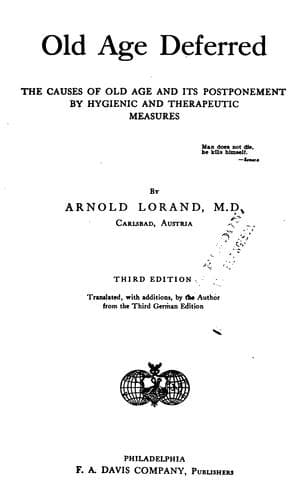
Old Age Deferred: The causes of old age and its postponement by hygienic and therapeutic measuresLorand, Arnold
Science
Old Age Deferred: The causes of old age and its postponement by hygienic and therapeutic measures
Lorand, Arnold
Hygiene; Longevity; Old age
It is an absolute fact that in those who are addicted to a diet of
carbohydrates, intestinal putrefaction is diminished, owing to the
formation of lactic acid from the fermentation of the milk-sugar which
is contained in such carbohydrates.
Intestinal putrefaction is enhanced by the alkaline contents of the
intestines; it can, therefore, be checked by various agencies that
diminish the alkalinity of the intestine, such, for instance, as by
lactic acid, just referred to. Fatty and acetic acids also effect this;
likewise fatty food, which promotes the formation of fatty acids. Cheese
may produce fatty and also lactic acids; wherefore it is of value to
combat putrefaction in the intestines. Of the further benefits of cheese
as an article of food, we make mention in the chapter on the hygiene of
food; we also state there that it is unsuitable in those cases in which
the intestines are not in thorough order.
Great care should be exercised in the quality of the food. The freshness
of various foods is of the greatest importance to the intestines, since
the main function of the stomach is principally a mechanical one,
serving to reduce the food into a convenient form and carry it to the
intestines, ready to be there prepared, through the influence of the
intestinal juices, into a condition fit for absorption and assimilation.
During this process the food is being reduced to its simpler elements,
and the more noxious substances are being freed to commence their
baneful activity. These substances first of all create an inflamed
condition of the intestines; then, being absorbed into the blood, they
cause a general intoxication. Fortunately they are not frequently
absorbed, and thus their injurious effect is limited to the intestine.
Among other such injurious foods we may mention fish and oysters,
sausages and meats that are in a state of decomposition; fruit that is
unripe or unsound; and canned food in which certain drugs are used as
preservatives, such being poisonous in varying degree, examples being
salicylic boracic, and sulphuric acids, etc., and at times even the
terrible poison, verdigris. Fresh food should always be preferred to
canned food, or to food preserved in other forms for too long a period
(see also chapter on the hygiene of food).
The stomach, and intestines also, can frequently suffer damage from ice
cold drinks, especially if taken habitually and in large quantities. As
already mentioned in the chapter on the hygiene of the kidneys, we
should never forget that every sort of food or drink must pass a series
of delicate epithelia of our noblest organs, which can be injured by
sharp and poisonous substances with which they come in contact.
Public-domain text, read in full here on John Shaqi.
Reviews
Reviews
No reviews yet
Be the first to share your thoughts on this work.
Elsewhere in the archive
Join the Discussion
Join the discussion
Sign in to leave a comment or review.
Sign InorCreate an account