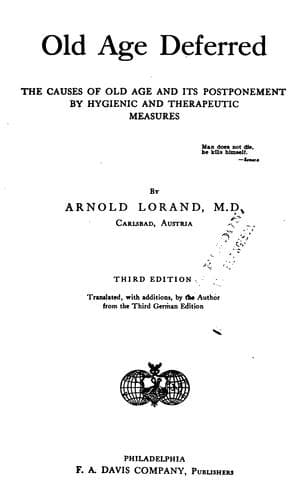
Old Age Deferred: The causes of old age and its postponement by hygienic and therapeutic measuresLorand, Arnold
Science
Old Age Deferred: The causes of old age and its postponement by hygienic and therapeutic measures
Lorand, Arnold
Hygiene; Longevity; Old age
It thus happens that people, under the impression that a good daily
stool has produced a clean bowel, still have a residue, and this can
instantly be seen by removing the same by purging drugs. We, therefore,
recommend the weekly use of a reliable purgative, such as bitter water,
thus cleaning the bowels of all residue, which frequently remains in
deep haustra of the intestines, as in Barlow’s disease.
The stagnation of fæces around the cæcum may also facilitate the
development of appendicitis, this being frequently due to neglect of the
hygiene of the intestines. It is also one of the commonest diseases, as
we will show in the succeeding chapter.
------------------------------------------------------------------------
CHAPTER XX.
HYGIENE OF THE INTESTINES—A FEW REMARKS ON THE CAUSE AND PREVENTION OF
APPENDICITIS.
APPENDICITIS, in these days, is one of the most frequent causes of an
unexpected death. As this work is designed to set forth the means by
which we may prolong life, it is desirable not to miss the opportunity
of offering a few remarks, in connection with the chapters on the
preservation of the intestinal functions, upon the cause and prevention
of an intestinal disease by which particularly young and promising lives
are frequently cut off.
In the previous chapters we saw that the cæcum was one of the places of
selection for the stagnation of the fæcal contents in the intestinal
canal. As the pressure of such fæcal matter in the cæcum and colon is
greatest toward the appendix the contents may go more easily into than
away from the appendix, and particularly so when, from a long rest in
the cæcum, they are thickened. The return of fæcal matter from the
appendix is often hindered by a spindle-shaped thickening at the
junction of the appendix with the cæcum, which presents the appearance
of a narrow bridge.
This thickening of the mouth of the appendix is the consequence of the
very close contact of the psoas muscle, upon which, in many people, the
appendix lies, so to speak resting upon it. This has been shown by
Offerhaus[219] (a surgeon in the Hague Hospital) to be the case in 62
per cent. of normal men.
Footnote 219:
Offerhaus: Proefschrift, “Eine mechanische oorzaak voorhet ontstaan
van Appendicitis,” Leiden, 1901.
In certain movements, such as running or cycling, the psoas is
continually pressing against the appendix, and it is natural that such
continuous pressure against this organ will in time leave a permanent
mark, which is, indeed, seen in many cases of appendicitis. After a
certain time a circumscribed segmentation will be visible on the parts
of the appendix which are in contact with the psoas, and later this
becomes so marked that a circular kinking results, establishing the
narrow bridge to which we have already referred.
Public-domain text, read in full here on John Shaqi.
Reviews
Reviews
No reviews yet
Be the first to share your thoughts on this work.
Elsewhere in the archive
Join the Discussion
Join the discussion
Sign in to leave a comment or review.
Sign InorCreate an account