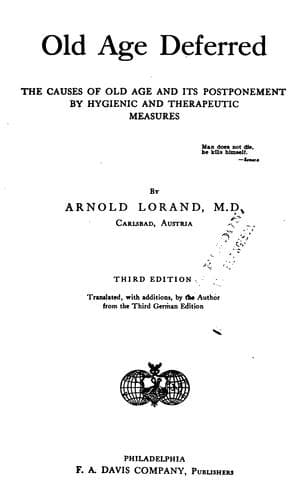
Old Age Deferred: The causes of old age and its postponement by hygienic and therapeutic measuresLorand, Arnold
Science
Old Age Deferred: The causes of old age and its postponement by hygienic and therapeutic measures
Lorand, Arnold
Hygiene; Longevity; Old age
That the retention of various harmful products normally eliminated
through the skin is extremely injurious to health is best shown by the
fact that animals whose skin is varnished all over invariably succumb to
intoxication. Especially is this true in amphibia, who, as
Spallanzani[234] found, can live longer after the removal of the lungs
than after varnishing the whole skin. The cause of this is that in
amphibia the respiration by the skin is more important than that through
the lungs.
Footnote 234:
Memorabilien traduits par Levebier, p. 77, Genève, 1863.
But even if, in higher animals, there is far more respiration through
the lungs than through the skin, the varnishing over of the skin on the
entire body can produce death in certain mammalia. This has also been
observed to have occurred in man. The day before the solemn entry into
Rome of Pope Leo XIII, a little boy was painted over his entire body
with gold leaf so as to represent an angel; but he suddenly died before
the procession began. We cannot, however, conceal the fact that the
death of higher animals, according to some authorities, is not due to
the retention of the products of perspiration, but rather to an
increased loss of warmth of the body, especially as these animals have
always been shaved prior to being varnished.
Still, for reasons we shall give later, we believe that this cannot
alter our views on the harmfulness of checking respiration through the
skin. The injurious action of this is also shown by the fact that
persons whose skin is burnt to a large extent, die, as a rule, by
intoxication. Certain opinions have been advanced which ascribe such a
death to a change in the constitution of the blood after extensive
burns. I am inclined to think that death may be due to the fact that the
skin respiration is, in such a case, more suppressed, as the body is
enveloped in bandages which, like sticking plaster, do not admit of air
circulation; and also because there is no elimination. At the same time
the other parts of the body are covered by the clothing instead of the
same being removed. If, however, after such burns the body be kept quite
naked and the air thus permitted a free circulation on all sides, then
even after the most extensive burns death will not follow, as we have
seen in several cases so treated by Dr. Sneve in St. Paul, Minn., whose
wards we inspected some years ago. Why should the changes in the blood
not induce death in these patients in the same way as it does in
patients swathed in bandages? Logically, this cannot be the reason for
death, but in all probability it is the suppression of the skin
respiration. But if death after extensive burns is due to this cause,
then the same may be given as the cause of death after varnishing the
body. The substances which are eliminated from the body through
perspiration are urea, uric acid (in small quantities only), common
salt, creatin, acetic acid, lactic acid, and a number of fatty acids.
Public-domain text, read in full here on John Shaqi.
Reviews
Reviews
No reviews yet
Be the first to share your thoughts on this work.
Elsewhere in the archive
Join the Discussion
Join the discussion
Sign in to leave a comment or review.
Sign InorCreate an account