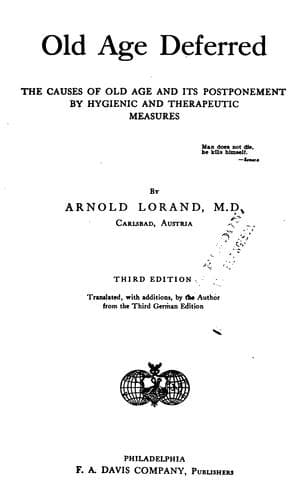
Old Age Deferred: The causes of old age and its postponement by hygienic and therapeutic measuresLorand, Arnold
Science
Old Age Deferred: The causes of old age and its postponement by hygienic and therapeutic measures
Lorand, Arnold
Hygiene; Longevity; Old age
EVERY day we are getting rid of the superficial layers of the skin,
which process can become so intense in some people that the skin looks
as though it were covered with flour dust; and in some persons with dry
skin such apparel as stockings sometimes gets full of this. These minute
scales, which get necrotised in the upper parts of the skin, are apt to
clog the pores, which can also become closed by particles of dust, or by
products of the sebaceous glands and by perspiratory residues. As the
free entrance of air to the pores is an essential condition for skin
respiration, and as the elimination of harmful products is only possible
when the pores remain open, we must get rid of the foreign matters which
clog them, for which purpose we take a bath. But water alone, even if it
be hot, is not able to effect a thorough cleansing of the skin on
account of the oily substance which is secreted by the sebaceous glands;
so, to obtain the fullest cleansing effects, we add the use of soap and
a brush, as already mentioned before. We must rub the soap well in, and
then rub it off energetically, if we desire to benefit by a fully
hygienic bath.
As we are daily getting rid of the above-mentioned skin scales, so it
behooves us to take a daily bath. It is not necessary to stay in the
bath more than ten to twelve minutes, or at the most fifteen. For the
reasons above mentioned the effect of bathing is a rational hygiene of
the skin.
By the action of the water, soap, and brush friction the skin receives
more blood, which is, at the same time, a great advantage to the
internal organs, as the blood drawn away from them facilitates the
circulation through them should they be congested. When more blood
reaches the skin the muscles that contract the pores are also better
nourished, and they then react better to certain agencies—cold, for
instance. They quickly contract the pores, so that the blood will be
kept back in the interior of the body and a cooling off of the periphery
of the body, with its dangerous consequences from catching cold, may
thus be avoided.
A daily bath can also be advantageous for those who perspire too freely.
After a bath, and this is one of its greatest advantages, the insensible
perspiration is much increased, and more water leaves the body through
the pores than before, and when a bath has been too hot, a very free
perspiration may ensue. But usually with people with a too free
perspiration, this tendency would be diminished, as it can often be
noted that those who daily take a lukewarm bath perspire less than
others on warm summer days.
Besides exciting the functions of the skin baths are also an excellent
means for diminishing a possible overwork of the kidneys, and thus
keeping them in good condition. It is possible to eliminate, through
bathing, such products by the skin which otherwise would have to be
eliminated through the kidneys.
Public-domain text, read in full here on John Shaqi.
Reviews
Reviews
No reviews yet
Be the first to share your thoughts on this work.
Elsewhere in the archive
Join the Discussion
Join the discussion
Sign in to leave a comment or review.
Sign InorCreate an account