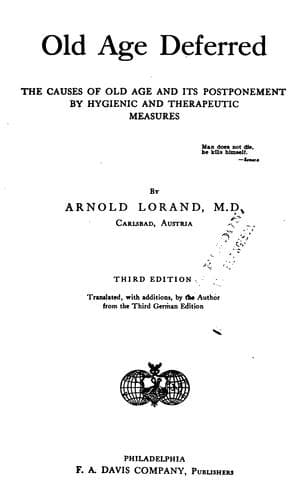
Old Age Deferred: The causes of old age and its postponement by hygienic and therapeutic measuresLorand, Arnold
Science
Old Age Deferred: The causes of old age and its postponement by hygienic and therapeutic measures
Lorand, Arnold
Hygiene; Longevity; Old age
In cases of chronic intoxication and such like diseases of metabolism,
such as gout, and in cases of old age, perspiration induced by very hot
baths, providing the circulatory system is in good condition, should be
tried and given often if the results prove satisfactory, as we thus
obtain the benefit of the bath and also of the perspiration.
The sweat baths should not exceed 15 to 20 minutes in duration unless
they are well borne, when a few more minutes may be added. In old people
cold douches should not be resorted to, but directly after the bath they
should be put to bed, which should have been previously warmed by
hot-water bottles. In persons where the processes of oxidation are
diminished and the skin very inactive, as is the case with many aged
people, such baths give very excellent results.
Sweating improves the functions of the kidneys in a much greater degree
than those of the skin. By insensible perspiration water is eliminated,
together with certain harmful solid products which otherwise would make
their way through the kidneys; this occurs much more so when the
perspiration is greatly increased by sweating processes. In such cases
about a liter of water can pass through the skin daily, and in addition
a considerable part of the nitrogenous end-products of metabolism and of
common salt. It has been discovered by Professor Hermann Strauss[238]
that in a liter of sweat, under favorable circumstances, fully six
grammes of common salt can be removed from the body. Leube once found
2.31 grammes of chlorides in 800 grammes of sweat.
Footnote 238:
Deutsche Med. Wochenschrift, p. 34, 1904.
Of nitrogenous bodies, according to Strauss, about 2 grammes can be
removed through the skin daily, and according to Professor von
Noorden[239] only 1 gramme. Leube discovered, about thirty years ago,
that the amount of nitrogen in the urine was 2 grammes less on such days
as sweating processes had been used than was usual on other occasions.
Kovesi and Roth-Schulz found 29 grammes of nitrogen and 29 grammes of
common salt in the sweat of patients suffering from Bright’s disease.
Strasser and Blumenkranz found, after electric light baths, a
considerable increase in the elimination of common salt up to 18
grammes, 4 grammes more than had been ingested. Nitrogenous bodies have
also been eliminated in larger quantities than have been introduced, as
has also more water. This has been proved in experiments on the effects
of bathing, in which people with diseased kidneys have been used as the
subjects. In these cases the elimination of common salt and nitrogenous
products is certainly greater than in normal individuals. Still there
can be no doubt that with such, by perspiration and bathing, an
increased elimination of these products can be obtained.
Footnote 239:
v. Noorden: Pathologie des Stoffwechsel, vol. i, 1906.
Public-domain text, read in full here on John Shaqi.
Reviews
Reviews
No reviews yet
Be the first to share your thoughts on this work.
Elsewhere in the archive
Join the Discussion
Join the discussion
Sign in to leave a comment or review.
Sign InorCreate an account