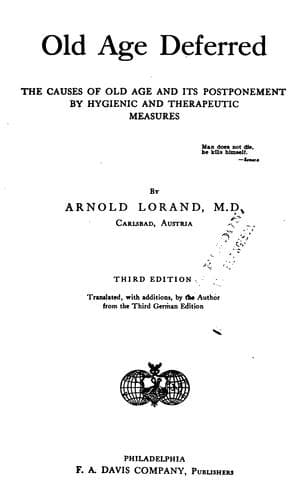
Old Age Deferred: The causes of old age and its postponement by hygienic and therapeutic measuresLorand, Arnold
Science
Old Age Deferred: The causes of old age and its postponement by hygienic and therapeutic measures
Lorand, Arnold
Hygiene; Longevity; Old age
The chemical action of sunlight is exercised by the blue and
ultra-violet rays (Finsen), and the heat comes mainly from the red rays.
From our point of view, however, the chemical rays play the more
important part.
When we sit in the sun for a long time and get an inflamed skin, this is
due mainly to the chemical rays. This fact was established by Charcot on
the basis of clinical observations. Charcot’s work has been confirmed by
the researches of Widmark, and especially by the exact experiments of
the famous Danish physician, Niels Finsen,[243] in 1906. The latter
showed that when strong light killed bacteria, this was due to the
action of the chemical rays alone, and, specifically, to the
ultra-violet rays. He also showed that these are the rays which produce
dilatation of the blood-vessels and an inflammatory condition of the
skin.
Footnote 243:
Finsen: “Om anvendelsen af concentrerede chemiske Lysstraaler,”
Kjöbenhavn, 1896.
To the red cheeks of those people who pass much time in the open air and
sun, we can compare, as a contrast, the pale faces with a greenish hue
of those who live in the dark, like polar explorers. If strong light
dilates the blood-vessels, and sends much blood to the periphery of the
body, thus promoting the insensible perspiration and metabolism, on the
other hand, in the long night of the arctic regions there is contraction
of the blood-vessels, and the blood is kept back in the interior of the
body, with the retention of excretory products. It has been shown by
Oerum,[244] through experiments on animals, that the quantity of their
blood and its percentage of hæmoglobin is dependent upon the light. They
are reduced in the darkness and increased in the light. Through a light
bath the quantity of blood was increased 25 per cent. within four hours.
Finsen[245] has also found, through examination of twenty-nine persons,
that there is less hæmoglobin in the blood in winter than in summer, due
to the lack of sunlight in winter. Grawitz and Graffenberger have seen a
diminution of the hæmoglobin, as also of the quantity of the whole
blood, in animals which were kept in the dark. Marti found that the red
blood corpuscles are diminished in such animals, but become augmented
when they are again exposed for a time to the sunshine.
Footnote 244:
Oerum: Pflüger’s Archiv. f. d. g. Physiologie, vol. cxiv.
Footnote 245:
Hospitalstidende, p. 1209 and 1239, 1894.
We should aim to get our share of direct sunlight in the open air, for,
as Finsen has shown, the valuable chemical rays of the sun are excluded
by glass; and, after all, it is not warmth alone we seek, but also the
chemical and anti-bacterial action of the sunlight, together with its
effects upon the blood-vessels and nervous system.
Public-domain text, read in full here on John Shaqi.
Reviews
Reviews
No reviews yet
Be the first to share your thoughts on this work.
Elsewhere in the archive
Join the Discussion
Join the discussion
Sign in to leave a comment or review.
Sign InorCreate an account