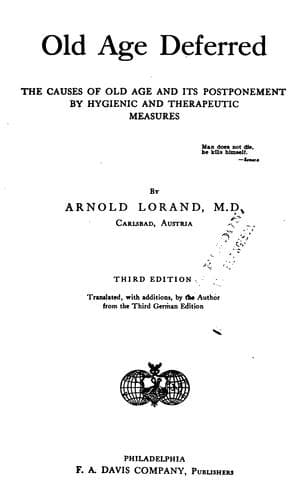
Old Age Deferred: The causes of old age and its postponement by hygienic and therapeutic measuresLorand, Arnold
Science
Old Age Deferred: The causes of old age and its postponement by hygienic and therapeutic measures
Lorand, Arnold
Hygiene; Longevity; Old age
If we now take such tuberculous persons and place them in a hospital or
sanatorium and subject them to the open air treatment, compelling them
to pass all their time exposed to the fresh air, both day and night, we
soon witness a marvelous change. Their appearance is improved, and also
their appetite; and after a time in most of the cases there will be an
increase in bodily weight. We thus see that the open air produces
wonderful effects in such persons, who, as a rule, have been immured in
close places, they shattering their health.
We have thus witnessed the clinical demonstration of the fact that fresh
air is able to improve our health. Fresh air contains much oxygen, and
this is a most indispensable substance, for without it we cannot live.
The red corpuscles in the blood which, loaded with carbonic acid, the
veins convey to the lungs, eagerly absorb the oxygen from the air that
we inhale and then convey it to the tissues to satisfy their
requirements for this precious substance.
By absorbing oxygen the elimination of carbonic acid is at the same time
facilitated. The greater the number of red blood corpuscles that comes
to the surface of the lungs the greater will be the volume of oxygen
which is taken into the system, and afterwards the larger will be the
volume of carbonic acid gas expelled. Thus in the lungs there takes
place a distintoxication of the organisms, and, according to certain
authorities, the cells of the lungs are co-operating in this process in
a manner analogous to the internal secretion by the cells of other
glandular structures.
The more fresh air, i.e., the more oxygen we get into our lungs, the
more we can contribute to the processes of oxidation in the tissues.
When the processes of circulation and of breathing are checked, and when
insufficient oxygen is absorbed, we soon see a very important change for
the worse in the condition of such persons, as exemplified by cases of
heart and lung trouble.
Given the great importance of oxygen, we must try by every means to get
as much of it into our lungs as possible; we shall get more of it from
air that is not stagnating, but always in circulation. When we are in a
closed room, after a certain time we absorb all the oxygen in it,
particularly when there are several persons present who are sharing with
us the oxygen in the air.
Staying for a long time in air so vitiated that it contains but little
oxygen and much carbonic acid and many microbes exhaled by the others,
we are liable to reap the disadvantages we have set forth in the chapter
on the dangers of a close room. According to Pettenkofer, the
exhalations from the persons present in a close room are much more
noxious than the carbonic acid gas. We, therefore, open the window and
door in order to create a current of fresh air, and so allow the oxygen
to be renewed. In this we but imitate nature, which sends a wind to
purify the close atmosphere on warm summer days. This is natural
ventilation.
Public-domain text, read in full here on John Shaqi.
Reviews
Reviews
No reviews yet
Be the first to share your thoughts on this work.
Elsewhere in the archive
Join the Discussion
Join the discussion
Sign in to leave a comment or review.
Sign InorCreate an account