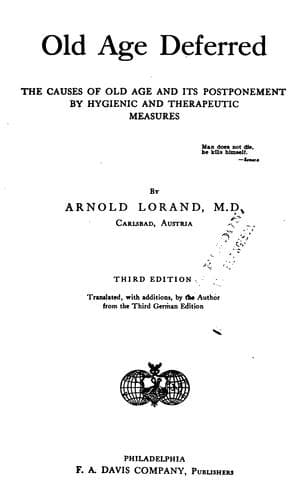
Old Age Deferred: The causes of old age and its postponement by hygienic and therapeutic measuresLorand, Arnold
Science
Old Age Deferred: The causes of old age and its postponement by hygienic and therapeutic measures
Lorand, Arnold
Hygiene; Longevity; Old age
It is natural that if we practice these exercises in the fresh air of
the forests or mountains their salutary action will be still more
pronounced. But if we are too indolent to perform the regular breathing
exercises, whose beneficial effect upon the heart’s nutrition and action
is so great, it will suffice for us to take deep inspirations and
expirations while walking. We must get into the habit of doing this
every day, and thus prolong our life.
As a general rule we only breathe with one part of our lungs, sadly
neglecting the other, by which the aëration of the blood will not be so
thorough. Independently even of the breathing exercises, it would be
very advantageous to our health if we gently took a long breath, which
should be so prolonged that we feel our stomach distended. The air will
thus reach the deeper portions of our lungs. This will also be the best
practice while singing; indeed, the latter would be the very best of
ways in which to obtain a good and thorough aëration of the lungs. We
have heard of cases where people without a voice have taken singing
lessons, for the simple reason that they were descended from families in
which tuberculosis was hereditary.
This latter disease is one of the most frequent causes of a shortened
existence, and it is, therefore, our duty to point out here the great
advantages not only of a generous diet, consisting of a certain amount
of underdone fresh meat, uncooked milk of healthy cows or goats, and
many eggs, sausages and puddings made of the blood of pigs (see Chapter
XXXIX), but also of regular deep breathing, thereby permitting of the
entry of oxygen to all parts of the lungs.
We always recommend breathing through the nose, as doing so through the
mouth dries up the mucous membranes, especially if throughout the night,
during sleep, the mouth is kept open. This bad habit permits of the
entrance of cold air which, not being warmed by passing through the
nasal passages, may be injurious to the lungs. The Indians are fully
cognizant of this fact, for in some tribes the mother binds up the mouth
of her child and thus compels it to breathe through the nose.
In the foregoing we have shown the great advantages of abundant fresh
air. We have referred to the fresh appearance of country people,
especially of those who live on mountains, as also to the improved
condition of tuberculous persons after having been exposed to as much
fresh air as possible. I ask, therefore, why, if people suffering from
this disease derive so much benefit from fresh air, should not we, who
are still healthy, be also benefited by it? Let us therefore remain in
the open air as much as possible, and never prevent its close approach
to us; for it gives health, long youth, and a good old age.
------------------------------------------------------------------------
CHAPTER XXXII.
ON THE DANGERS OF LIVING IN CONFINED AND ILL VENTILATED QUARTERS.
Public-domain text, read in full here on John Shaqi.
Reviews
Reviews
No reviews yet
Be the first to share your thoughts on this work.
Elsewhere in the archive
Join the Discussion
Join the discussion
Sign in to leave a comment or review.
Sign InorCreate an account