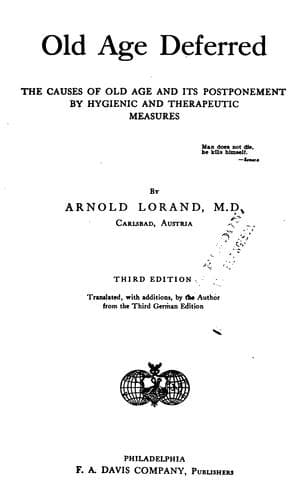
Old Age Deferred: The causes of old age and its postponement by hygienic and therapeutic measuresLorand, Arnold
Science
Old Age Deferred: The causes of old age and its postponement by hygienic and therapeutic measures
Lorand, Arnold
Hygiene; Longevity; Old age
THE leading principle in the use of food is that we should eat to live,
but not live to eat. It is certain that more people die from eating too
much than too little. It is wonderful to consider how little food
animals, or human beings, can exist upon for a long time and remain in
good health; and it is certain that the foundations of many diseases are
laid by excessive eating. It must be borne in mind that the elaboration
and assimilation of a large quantity of food requires the activity, or
even hyperactivity, of several of our most important organs, upon the
condition of which our length of life depends. And here we may repeat
the statement that has been made so often in the course of this book,
that overactivity of an organ may be followed by its exhaustion. By
laying too great a burden upon an organ, and continually overworking it
without giving it any rest for recuperation, we are burning the candle
at both ends, and rapidly exhausting the vitality of such important
organs as the liver, kidneys, pancreas, stomach, and intestines, not
forgetting those important glands, the thyroid and parathyroid, which
take a great share in the destruction of poisonous products formed in
our bodies from the end-products of food.
We have just mentioned that with very little food animals, or human
beings, can live for a long time. But prolonged underfeeding may be
quite as dangerous as overfeeding. In starvation the resistance against
infectious diseases, and especially tuberculosis, is diminished. This
disease, the most common of all maladies, is found most often in
underfed people, especially if they live in confined localities with
little air and no sunshine. Moderation in food, as in everything else,
is the only way to attain a happy old age.
The Romans had a very appropriate proverb which ran: “Omne quod est
nimium, vertitur in vitium,” “Everything in excess becomes a vice.”
Much depends upon the quality of the food we take, for some foods are of
very little nutritive value; and even of the most nutritive food, some
parts may pass out as waste products, because those organs which
elaborate and assimilate food may be partially, or wholly, changed by
disease, and so unable to fulfill the work for which they are destined.
Therefore, given a moderate amount of food, the condition of the body
and the maintenance of strength will depend mainly upon the nutritive
value of that food. An exact method of estimating the nutritive value of
food has been shown by Frankland, Stohmann, Danilewsky, and Rubner.
Public-domain text, read in full here on John Shaqi.
Reviews
Reviews
No reviews yet
Be the first to share your thoughts on this work.
Elsewhere in the archive
Join the Discussion
Join the discussion
Sign in to leave a comment or review.
Sign InorCreate an account