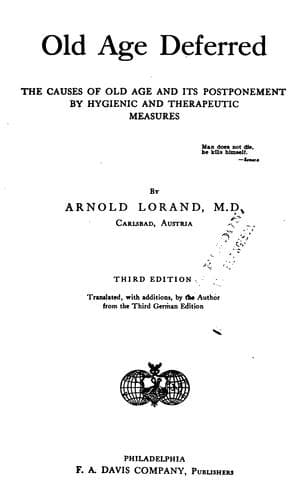
Old Age Deferred: The causes of old age and its postponement by hygienic and therapeutic measuresLorand, Arnold
Science
Old Age Deferred: The causes of old age and its postponement by hygienic and therapeutic measures
Lorand, Arnold
Hygiene; Longevity; Old age
The digestibility of these various kinds of food is calculated for the
normal stomach. By following the above table we can make the best choice
of easily digestible food. Especially for aged persons we should choose
such, and at the same time we should mince them, or give them in the
form of porridge, which is still better. We must do this because aged
persons do not possess, as a rule, good teeth, if any, and thus cannot
fulfill the demands of mastication, which we will treat of later on in a
separate chapter.
The food should not be too hot nor too cold, as, if it is, the stomach,
and even intestines may be damaged; on the other hand, as a rule, warm
food disappears sooner from the stomach; but there are many exceptions
to this rule.
The keynote in the hygiene of food is moderation. We should never eat
more than necessary to satisfy hunger. Most people know when they have
had enough; and as a rule animals never eat more than enough to satisfy
them, and then they will refuse more food. But with the intelligent
human being it is different, and there are not a few who eat more than
they require, and thus dig their graves with their teeth. Moderation is
all important; it is, indeed, the cause of longevity of those persons
who live about 100 years.
We know the story of Cornaro, who became ill at 40 through immoderate
living. He recovered his health by reducing his food to the necessary
amount only, and then lived, happy and healthy, to 100 years. Mr. Horace
Fletcher,[262] and many other persons, have recovered their health
through moderation in food, after having come to the brink of death
through immoderation. Such examples we may often see, and they are
eloquent advocates of moderation in diet.
Footnote 262:
Loc. cit.
We will show later that we can only digest food that we eat with relish;
therefore never let us be persuaded to partake of food, or compel
ourselves to eat, when we are not hungry. Therefore, at least six hours
should pass between dinner and supper, and five hours between breakfast
and dinner. It is more healthy, and especially conducive to healthy
sleep, to have dinner at 12 or 1, and supper at 6 or 7. Meat should only
be taken once a day, at dinner, and in the evening much less should be
eaten than at noon. Meat should never be taken for breakfast. We would
recommend the following diet:—
BREAKFAST.
Grape fruit or oranges, 2 eggs (soft boiled), cereals, stewed fruit,
white or brown bread, fresh butter, a teaspoonful of marmalade or other
kind of jam, fresh cherries, or fresh strawberries, or other fruit in
season, especially grapes, half to one pint of milk.
DINNER.
Soup, fish or meat, vegetables, stewed fruit, fresh fruit, white or
brown bread.
SUPPER.
Like breakfast: one pint of milk, or half a pint of sour milk, kefir, or
koumiss. Also, if liked, sour milk during the day.
Public-domain text, read in full here on John Shaqi.
Reviews
Reviews
No reviews yet
Be the first to share your thoughts on this work.
Elsewhere in the archive
Join the Discussion
Join the discussion
Sign in to leave a comment or review.
Sign InorCreate an account