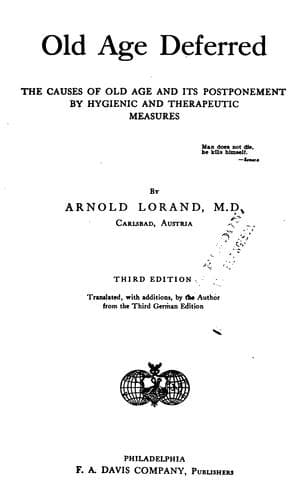
Old Age Deferred: The causes of old age and its postponement by hygienic and therapeutic measuresLorand, Arnold
Science
Old Age Deferred: The causes of old age and its postponement by hygienic and therapeutic measures
Lorand, Arnold
Hygiene; Longevity; Old age
A vegetarian diet, with milk and a few eggs daily, is the best
nourishment for old people; the greater the age the more of the latter
should be taken. In fact, persons advanced in age will do well to eat
very little meat, for reasons which are fully given in the chapter on
the dangers of a too abundant meat diet.
We have thus seen that a vegetarian diet can give the best results, not
only in the prevention and cure of many diseases, but also in the
preservation of health in old age. It is a fact that we often see
persons who follow such a diet looking much fresher and more youthful
than those who partake of much meat, especially when they have passed
the seventies.
But if milk and vegetarian diet, with a few eggs daily, can be taken for
many years and yield good results, it is quite a different case with
those people who are in the habit of living only on vegetables to the
exclusion of any article of animal food; such are vegetarian fanatics,
and if they keep up this deleterious habit for a lengthened period, they
must inevitably suffer for it.
Even if we do not admit the pretensions of certain authors, who declare
that the albumin of the vegetable is less nourishing than the albumin of
animals, still it is impossible for us to introduce into our bodies the
quantity of vegetables which would contain the number of calories
necessary in order that we should not suffer from a deficiency of them,
and at the same time would allow for waste. To satisfy the requirements
of our bodies we would have to eat enormous quantities of vegetables and
thus overload the stomach and intestines, with the result that even the
strongest stomach would undoubtedly give way after a certain time, and
dyspepsia, especially sour stomach, and eventually atony, and in many
cases even dilatation, of the stomach would follow; and abnormal
fermentation would readily take place in the intestines after a certain
time. Consider, also, what large amounts of enzymes, how much saliva,
hydrochloric acid, bile, etc., must be produced in order to insure a
good digestion and assimilation of the food, though it is of course true
that the ferments, at least, can readily act in a very small degree upon
large quantities of food. Vegetarian diet has also the drawback that,
for reasons already mentioned, more salt must be taken when we partake
of it.
There are many people who develop hyperchlorhydria after a vegetarian
diet, and we frequently had to have our patients abandon such a diet
when they got acid stomachs; and they only recovered from these ill
effects after animal food had been given in certain quantities. It is
certain that the present capacity of the stomach and intestines, and
their present anatomical and histological structure, also, is not
sufficient or adequate for the continued use of a vegetarian diet, the
greatest danger of which lies, however, in the threatening
_under_-nutrition, and in consequence the imminent danger of bacterial
infection.
Public-domain text, read in full here on John Shaqi.
Reviews
Reviews
No reviews yet
Be the first to share your thoughts on this work.
Elsewhere in the archive
Join the Discussion
Join the discussion
Sign in to leave a comment or review.
Sign InorCreate an account