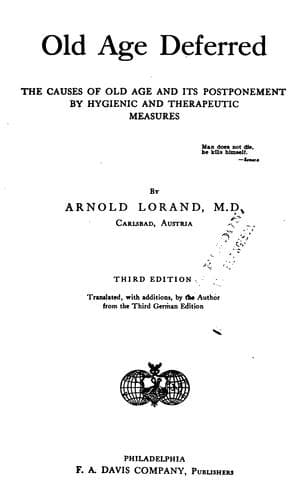
Old Age Deferred: The causes of old age and its postponement by hygienic and therapeutic measuresLorand, Arnold
Science
Old Age Deferred: The causes of old age and its postponement by hygienic and therapeutic measures
Lorand, Arnold
Hygiene; Longevity; Old age
In the same way the kidneys can also be kept in good condition if too
much meat be not taken. These eliminate the end-products of meat food,
and the more of such products that pass through the kidneys, the more of
them are taken from the blood and excreted by means of the fine
epithelia of the kidney tubules, and thus the more is the work done by
these organs; and we have mentioned that any overwork of an organ may be
followed by its exhaustion. As a consequence of eating meat sometimes
very harmful products pass through the kidneys, especially in the case
of preserved, strongly seasoned, or spiced meat, for such preserved food
may contain disease germs, ptomaine bodies, mineral poisons, etc. But
even the passage of normal end-products of meaty food—for example, if
urea be continually passed for years in large quantities—can produce
serious alterations. Many authorities, such as Dr. James Tyson, of
Philadelphia, who is well known by his works on the kidneys, attribute
to the very frequent taking of such food many cases of interstitial
nephritis; and nearly all such authorities, including Senator, of
Berlin, prohibit the use of meat in most of the disorders of the
kidneys. But we have already referred to the danger of such a diet to
the liver and kidneys, and it is only because of the importance of the
subject that we have again referred to the matter.
There is some clinical evidence in favor of the opinion that the
pancreas may also be altered by an abundant meat diet. We know that when
this organ is diseased we may discover a quantity of unabsorbed meat
fibers in the fæces, indicating that the pancreas has failed to fulfill
its task of assisting in the digestion of meat by the production of its
ferment—the trypsin. Meat, when taken in large quantities, can thus
cause the pancreas considerable overwork, which, in the long run, as is
well-known, may cause trouble, as is shown by the fact learned from
observation, that diabetes develops generally in meat eaters. Even in
dogs an abundant meat diet can produce spontaneous diabetes, a fact we
have already published. Diabetes may not only be due to the changes in
the pancreas, but also as we have shown[278] to those in the thyroid
gland, consequent upon such nourishment.
Footnote 278:
Lorand: “Die rationelle Behandlung der Zuckerkrankheit,” second
edition, Berlin, 1909.
It is a very important fact that much meat can become most injurious to
diabetic patients, and, as v. Noorden[279] observed, even slight cases
of diabetes can be transformed into severe ones in consequence of such a
diet; thus, in our opinion, in all severe cases of this disease meat
should be prohibited.
Footnote 279:
v. Noorden: Deutscher Naturforscher Congress, 1902.
Public-domain text, read in full here on John Shaqi.
Reviews
Reviews
No reviews yet
Be the first to share your thoughts on this work.
Elsewhere in the archive
Join the Discussion
Join the discussion
Sign in to leave a comment or review.
Sign InorCreate an account