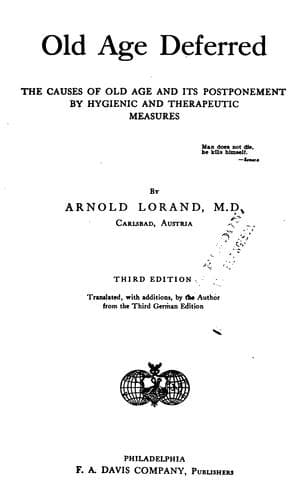
Old Age Deferred: The causes of old age and its postponement by hygienic and therapeutic measuresLorand, Arnold
Science
Old Age Deferred: The causes of old age and its postponement by hygienic and therapeutic measures
Lorand, Arnold
Hygiene; Longevity; Old age
Reading while eating is contrary to the above indications, unless
perhaps it be something humorous, like Mark Twain’s “Adventures of
Huckleberry Finn,” for instance. If we have the chance of choosing our
neighbors at the dinner table let us rather sit next some one having the
characteristics of Mark Twain than an undertaker or one who talks
business.
Besides the gastric juice the saliva also plays a very important rôle,
as it contains a valuable ferment which facilitates the digestion of
starch into sugar: the diastatic ferment. In order to have a good supply
of saliva the food must be kept longer on the tongue, as the flow of
saliva is best induced by the stimulation of the nerves of taste; so we
must masticate longer, and move the food between the teeth and on the
tongue for as long a time as possible, so that it will act on the nerves
of taste.
The secretion of the salivary glands under nervous influence is actuated
in the same way as is that of the gastric juice. It is powerfully
influenced by psychical impressions; for instance, by impulses coming
from sight to the nervous centers and thence to the salivary glands, as
can easily be seen by daily observation. If we offer a hungry dog a
sausage we shall all witness an abundant flow of saliva, and the same
may also be seen in man, and the German saying, “das wasser läuft im
Munde zusammen,” may be literally true.
The secretion of saliva can be provoked by much the same agencies as
that of the stomach juice, but above all by mastication. This has the
greatest effect on the flow of saliva, especially when accompanied by
good appetite; in fact, we may say good appetite provokes the flow of
saliva and mastication maintains it for a long time. We are thus able,
by abundant salivation, to aid digestion wonderfully, especially with
regard to starchy food, as the diastatic ferment of the saliva assists
in transforming starch into sugar; otherwise such material would be
rather difficult to digest, only depending then on the pancreatic and,
perhaps, intestinal ferments. Another great advantage of thorough
mastication is that the food reaches the stomach in the smallest
possible pieces, perhaps in liquid form, and thus the stomach juice can
reach it freely from all sides, whereby digestion is greatly
facilitated.
Not only the digestion in the stomach, but also the absorption of food
transformed into a liquid from the intestines is much assisted by
thorough mastication; while, as the result of insufficient mastication,
as with fast eaters, the food may cause much greater work to the walls
of the stomach. Being much less absorbed from the intestine it may
irritate it as a foreign body until expelled by greater efforts of the
intestinal walls. Long-lasting gastric and intestinal catarrhs may
result from insufficient mastication.
Public-domain text, read in full here on John Shaqi.
Reviews
Reviews
No reviews yet
Be the first to share your thoughts on this work.
Elsewhere in the archive
Join the Discussion
Join the discussion
Sign in to leave a comment or review.
Sign InorCreate an account