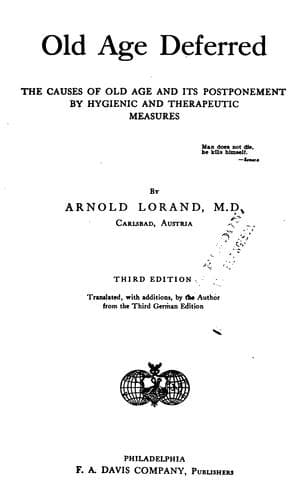
Old Age Deferred: The causes of old age and its postponement by hygienic and therapeutic measuresLorand, Arnold
Science
Old Age Deferred: The causes of old age and its postponement by hygienic and therapeutic measures
Lorand, Arnold
Hygiene; Longevity; Old age
According to several authors, whom we have already quoted (de
Quervain,[318] Hertoghe[319]), alcohol has a great influence on the
thyroid, and in chronic alcoholism the thyroid is found to be
degenerated.
Footnote 318:
Semaine Médicale, 1905.
Footnote 319:
Loc. cit.
If it can be admitted that drunkenness is caused by the toxic products
of the thyroid, due to the alcohol acting on the thyroid and causing its
hypersecretion, we can also explain the mystery why persons bitten by
poisonous snakes can also, in the same way, take very large quantities
of alcohol without showing its effects, even when they have previously
been quite unaccustomed to it. Snake poison, as do all poisons, creates
a hyperactivity of the thyroid which results in the throwing off of a
large amount of colloid substance. Exhaustion follows this
hyperactivity, and in this condition, as in convalescence from
infectious diseases, and in severe diabetes, where there is also a
similar exhaustion of the thyroid after a previous hyperactivity, a
large quantity of alcohol can be taken, merely because of the fact that
when the thyroid is devoid of its colloid, a condition of hyperactivity,
which is the cause of drunkenness, cannot easily be provoked, unless
enormous doses are given. We must, therefore, in cases of snake
poisoning give greatly increased doses of alcohol in order to again
provoke an increased activity of the thyroid, and thus cause the
eventual destruction of the harmful toxalbumins of the snake poison.
If women, in a state of convalescence after pneumonia, or with severe
diabetes, and unaccustomed to taking spirits, can stand large quantities
of alcohol without exhibiting any signs of excitation, it is very
probably due to the circumstance that the thyroid has already thrown off
its available amount of colloid, is exhausted, and the doses given are
not yet sufficient to produce a fresh secretion, and thus the symptoms
of drunkenness do not develop.
The result of these observations is that a degenerated thyroid cannot
easily provoke a condition of drunkenness, which may also explain the
curious coincidence that frequently chronic alcoholics, even after large
quantities of alcohol, do not present typical symptoms of drunkenness;
in fact, sometimes so few of such signs are visible that, if a crime is
committed under such influences, it is difficult to prove they were
really intoxicated at the time, as they present no visible signs of such
a condition.
Public-domain text, read in full here on John Shaqi.
Reviews
Reviews
No reviews yet
Be the first to share your thoughts on this work.
Elsewhere in the archive
Join the Discussion
Join the discussion
Sign in to leave a comment or review.
Sign InorCreate an account