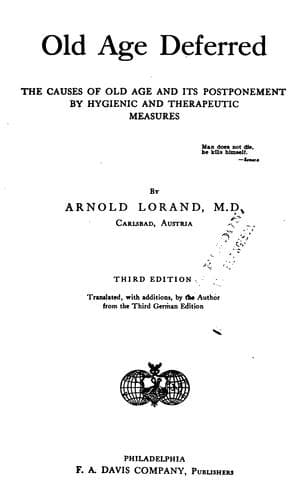
Old Age Deferred: The causes of old age and its postponement by hygienic and therapeutic measuresLorand, Arnold
Science
Old Age Deferred: The causes of old age and its postponement by hygienic and therapeutic measures
Lorand, Arnold
Hygiene; Longevity; Old age
If the bad qualities of the ductless glands are inherited, it is only
logical to expect the same for the good qualities also. It stands on
this basis that we may frequently find longevity in the same family.
Longevity, as illustrated by the many facts adduced in this book from
the field of clinical and experimental observations, is closely allied
with a thorough performance of the functions of the ductless glands,
especially of the thyroid gland; if these are in good condition, and
especially if proper hygiene is also observed at the same time,
longevity will follow. The good condition of the ductless glands is
largely dependent upon a life based on hygienic principles, although
when these glands are of the best quality they may stand a good deal and
not degenerate so soon, even after excessive activity following
injudicious or fast living.
But if a long life be dependent on a good state of the ductless glands
and if the qualities of these are inherited—which cannot be doubted
after the foregoing observations on heredity,—it must necessarily follow
that longevity is inherited too, and this is a fact which can be proved
by a large number of observations.
If we study the history of persons who have lived over 100 years, we
shall find in nearly every case that their forefathers, or their
descendants, or other relatives of the same blood have, as a rule, also
lived to a great age. This will be illustrated by a few examples which
we will now give.
In the year 1724 there died in Hungary in a village called Köprös, about
ten miles from Temesvar, a man, Petraz Czarten, who was 185 years of
age. When he died, his son was 95.
We have already referred to the case of a man named Thomas Parr in our
chapter on the influence of the sexual glands upon vitality and long
life. This man died in 1635 in his 153d year, and after death his body
was dissected by the great physician Harvey. That longevity had existed
in his family was shown by the fact that one of his female descendents
died in Cork, in Ireland, at the age of 103.
In the year 1797, in a village near Bergen, there died a man, Joseph
Surrington, in his 160th year. That he left a young widow, after having
been married several times, is not so extraordinary if we consider the
facts in the chapter in this book on the influence of the sexual glands
upon vitality and long life. When this man died his eldest son was 103
and his youngest only 9!
In a Finnish village near St. Petersburg there lived an old peasant
woman, Maria Willamow. She was born in 1692, and died on September 10,
1807, after having lived 115 years, 9 months, and 4 days; her brother
had already died in 1768 at the age of 108. All her relatives and
descendants were remarkable for their longevity.
Public-domain text, read in full here on John Shaqi.
Reviews
Reviews
No reviews yet
Be the first to share your thoughts on this work.
Elsewhere in the archive
Join the Discussion
Join the discussion
Sign in to leave a comment or review.
Sign InorCreate an account