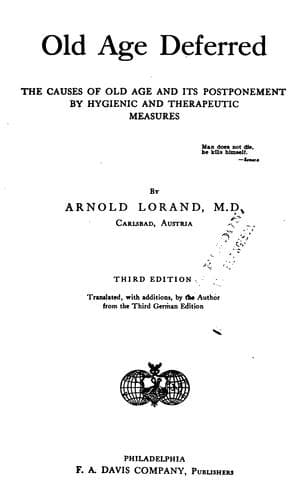
Old Age Deferred: The causes of old age and its postponement by hygienic and therapeutic measuresLorand, Arnold
Science
Old Age Deferred: The causes of old age and its postponement by hygienic and therapeutic measures
Lorand, Arnold
Hygiene; Longevity; Old age
The examination of the thyroid gland by palpation is a very difficult
undertaking and necessitates a thorough knowledge of the anatomy and
physiology of the gland. We must bear in mind the fact that, in men, we
generally find only two lobes, the lateral ones, which lie on either
side of the trachea, as the median lobe is generally undeveloped in the
male. The right lobe is usually larger than the left. In women the
median lobe is often well developed and can be distinctly seen in
enlargement of the gland, for instance, during puberty, menstruation,
pregnancy, etc., and especially when a goiter exists which, for reasons
we have mentioned previously, is more common in the female.
When the thyroid shows a considerable swelling, as in goiter, it can be
seen and felt easily, but not always, for cases certainly exist where in
life no thyroid could be felt, and yet at the autopsy a large goiter has
been found. Thus, in a case of acromegaly a thyroid of about 130 grammes
was found by Holsti,[119] though during life nothing could be discovered
by palpation. When a large thyroid can be seen and felt, we are
justified in diagnosing a swelling of the gland; but in cases where we
neither see nor feel it, we are not always justified in stating that it
is not enlarged.
Footnote 119:
Holsti: Zeitschrift für klin. Medicin, p. 272, 1892.
When palpating the thyroid we must note whether it is soft or hard. If
soft, the tissue present is probably parenchymatous in nature and so,
probably, entirely secreting tissue, while a goiter that feels hard may
denote excess of connective tissue, and thus, apparently, an inactive
gland. The presence of cystic formations raises the possibility of a
large quantity of colloid substance, either healthy or degenerate.
Thus, inspection and palpation of the thyroid can give us, to a certain
extent, valuable information; we must, however, not rely entirely upon
the results of this external examination but, especially in cases where
no thyroid can be felt, we must add to the external examination an
inquiry into the condition of those functions which are governed by the
thyroid—we must, in fact, examine the condition of those organs whose
function is dependent upon the internal secretion of the thyroid.
Public-domain text, read in full here on John Shaqi.
Reviews
Reviews
No reviews yet
Be the first to share your thoughts on this work.
Elsewhere in the archive
Join the Discussion
Join the discussion
Sign in to leave a comment or review.
Sign InorCreate an account