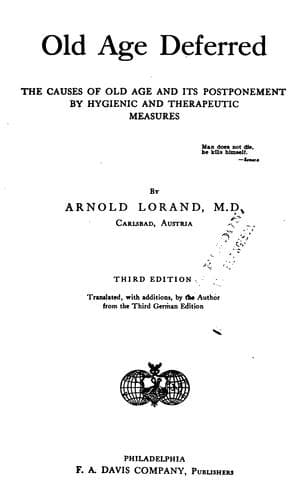
Old Age Deferred: The causes of old age and its postponement by hygienic and therapeutic measuresLorand, Arnold
Science
Old Age Deferred: The causes of old age and its postponement by hygienic and therapeutic measures
Lorand, Arnold
Hygiene; Longevity; Old age
We must not forget the very important fact, that even when we find no
sugar we cannot at once exclude diabetes. There are many cases of mild
diabetes which do not show any sugar on an ordinary diet. To recognize
these cases we must give them a test meal of either about three ounces
of grape sugar two hours after a light breakfast of coffee and a roll,
or, as we have recommended in our book on the rational treatment of
diabetes,[131] we must give a test meal of much starchy food, such as
rice and cakes, and examine the urine two hours later. If then no sugar
is found, or not exceeding 0.2 per cent., diabetes may be excluded.
Persons with 0.1 per cent. to 0.3 per cent. of sugar after such a
starchy test meal may be considered as on the border line of diabetes.
Such persons show a diminished tolerance of carbohydrates, and they have
lost the power to consume all the sugar they introduce into their body.
Therefore, especially if they come of diabetic parents, they should
avoid eating much starchy food so as not to develop further this
dangerous tendency.
Footnote 131:
Second edition, Berline, 1909.
Diabetes, in the majority of cases, considerably shortens the patient’s
life. Mild cases of diabetes may however live for fifteen or twenty
years, or often even longer. In predicting the chances of longevity in
diabetic subjects everything depends on the question whether diacetic
acid has been found in the urine or not. This can be easily ascertained
by putting a few drops of a solution of perchloride of iron into a test
tube with the diabetic urine. If diacetic acid is present, the liquid
will become Burgundy red in color, and the deeper this red color, the
greater is the percentage of diacetic acid present. In such cases the
chances are very bad, such patients living on an average for only one to
two years. Exceptions to this rule, however, are not infrequent, and we
know of a case of acromegaly with severe diabetes, who has passed large
quantities of diacetic acid for the last fourteen years.
Cases of severe diabetes, with diacetic acid, can often be easily
recognized by their appearance. They are thin, the cheeks are often
flushed, and they show nearly all the signs of a myxœdematous condition,
as already described, whereas cases of mild diabetes present often
symptoms of hyperactivity of the thyroid gland, as in exophthalmic
goiter. As we have shown, diabetes is often due to an overactivity of
the thyroid gland,[132] as well as to degeneration of the pancreas,
these glands being antagonistic to one another. This is confirmed and
amplified by Sajous, who ascribes one form of diabetes to overactivity
of the adrenal system, which includes the thyroid gland. Overactivity of
the latter organ may also be followed by its exhaustion, with symptoms
of myxœdema, as is the rule in severe diabetes.
Footnote 132:
“Die Entstehung der Zuckerkrankheit,” Berlin, 1903, and its French
translation, Maloine, Paris, 1904.
Public-domain text, read in full here on John Shaqi.
Reviews
Reviews
No reviews yet
Be the first to share your thoughts on this work.
Elsewhere in the archive
Join the Discussion
Join the discussion
Sign in to leave a comment or review.
Sign InorCreate an account