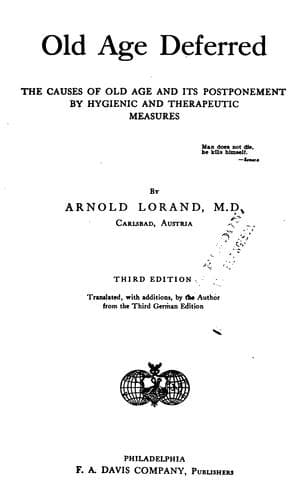
Old Age Deferred: The causes of old age and its postponement by hygienic and therapeutic measuresLorand, Arnold
Science
Old Age Deferred: The causes of old age and its postponement by hygienic and therapeutic measures
Lorand, Arnold
Hygiene; Longevity; Old age
The liver also produces certain bodies, as urea, which play a very
important part in metabolism, and it also serves as a large depot for
glycogen, the stored sugar of the body. The liver forms a large amount
of glycogen, and stores it up for the wants of the body. By a ferment,
also produced by the liver cells, the glycogen is transformed into
sugar, and in this form is given off to the body. If the liver were
extirpated the blood would contain no more sugar, as was found by
Minkowski through experiments on animals.
Besides sugar, the liver also produces, as just mentioned, another very
important substance, and this is urea. This body is produced in the
liver from ammonia, which, as the final product of decomposition of
albuminous substances, is brought to the liver by the blood. From
carbamic acid, also, the liver forms urea. Ammonia and carbamic acid are
poisonous products which arise from the decomposition of albuminous
material, and, by transforming them into urea, the liver saves our body
from continuous intoxication. Thus we can see that in diseases of the
liver the quantity of urea falls and the elimination of ammonia
increases. A normal man eliminates about thirty to forty grammes of urea
in a day. Much smaller quantities per diem would thus indicate
diminished activity of the liver.
Besides glycogen and urea, the liver also produces another substance,
which is indispensable to the perfect process of digestion and
assimilation. This is the bile. The bile transforms fat in the intestine
into an emulsion, and thus makes it possible for the fat-splitting
ferment of the pancreas to act upon it, and to split it up into glycerin
and fatty acids, and thus make it serviceable for the uses of the
organism. The bile augments the action of the pancreatic ferments; it
stimulates the movements of the intestine, and is a powerful antiseptic
to the contents of the intestine, as it hinders to a certain extent
their putrefaction. Another important action is that it increases the
water content of the fæces, and thus materially helps an easy evacuation
of the bowels.
Public-domain text, read in full here on John Shaqi.
Reviews
Reviews
No reviews yet
Be the first to share your thoughts on this work.
Elsewhere in the archive
Join the Discussion
Join the discussion
Sign in to leave a comment or review.
Sign InorCreate an account