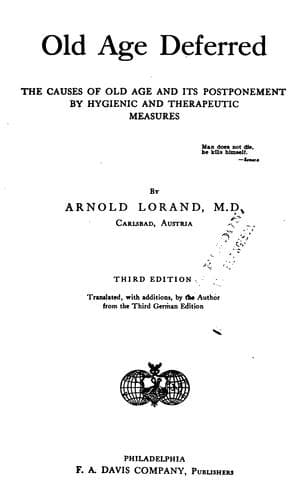
Old Age Deferred: The causes of old age and its postponement by hygienic and therapeutic measuresLorand, Arnold
Science
Old Age Deferred: The causes of old age and its postponement by hygienic and therapeutic measures
Lorand, Arnold
Hygiene; Longevity; Old age
We can readily understand why women with changes in the thyroid and
sexual glands are so often attacked by gall-stone disease. In these
women there is, as a rule, atony of the intestines, with habitual
constipation. This intestinal atony is also accompanied by an atony of
the gall-ducts, and so the bile is more or less stagnant in these ducts.
As shown by Morat and Doyon,[136] the gall-ducts contract rhythmically
every ten to twenty seconds, and the bile is thus expressed. The
periodical compression of the liver by the diaphragm at each inspiration
also helps this expression of the bile. Thus it flows under a certain
pressure through the choledochus, and it is easy to understand that the
billions of microbes which infest the intestines, will have great
difficulty in passing the narrow and tortuous passages of the bile-ducts
through which bile is circulating at great pressure. And this is of the
utmost importance, for if microbes are able to pass the common duct and
thus enter the bile-ducts, they will set up inflammation, as was shown
by several French authors: Gombault, Charcot, Gilbert, etc.
Footnote 136:
Traité de Physiologie.
Inflammation of the bile-ducts plays a most important part in the origin
of gall-stone disease, for, as Naunyn and his pupils have shown,
inflammation of the bile-ducts leads to a precipitation of cholesterin,
and so to the formation of gall-stones.
In women gall-stone disease is more frequent than in men. This depends
upon the greater frequency of diseases of the thyroid and sexual glands
in women. Changes in the sexual organs produce an irritation of the
splanchnic with checking of the peristaltic movements of the intestine
and, at the same time, relaxation of the muscular coat of the
bile-ducts. Thus there arises a deficient expression of bile, and
stagnation follows, with invariable immigration of bacilli producing
inflammation and precipitation of cholesterin and gall-stones. For the
above-mentioned reasons constipation is far more frequent in the female,
and constipation, being always accompanied by atony of the bile-ducts
with stagnation of the bile, directly exposes to the risk of gall-stone
disease.
In men gall-stone disease may often be considered a manifestation of old
age. It appears, as a rule, after the fortieth year, and is often
brought about by previous infectious diseases. In such cases obesity
often develops first, and later gall-stone disease. For those who are
interested in this subject we would refer to our communication[137] on
the origin of gall-stone disease following changes in certain ductless
glands. Considerable, sometimes enormous, loss of weight is a very
frequent symptom of gall-stone disease, and is probably due to
pancreatic alterations.
Footnote 137:
Archives générales de médecine, Octobre, 1905, and Monthly Cyclopædia
of Practical Medicine, 1906.
Public-domain text, read in full here on John Shaqi.
Reviews
Reviews
No reviews yet
Be the first to share your thoughts on this work.
Elsewhere in the archive
Join the Discussion
Join the discussion
Sign in to leave a comment or review.
Sign InorCreate an account