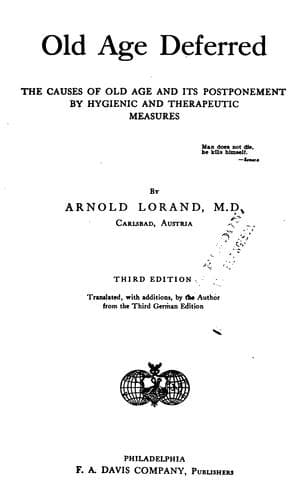
Old Age Deferred: The causes of old age and its postponement by hygienic and therapeutic measuresLorand, Arnold
Science
Old Age Deferred: The causes of old age and its postponement by hygienic and therapeutic measures
Lorand, Arnold
Hygiene; Longevity; Old age
Let us add that, luckily, not every thyroid shows important changes
after the age of forty or fifty, although there is usually a slight
increase of connective tissue at that age. On the other hand there are
thyroids in subjects of advanced age which show no important
degenerative change. This, however, is, according to our experience at
autopsies, a very rare occurrence. The point of main importance is the
amount of colloid substance present. A thyroid with much colloid, if it
is of normal quality (which can be recognized by the way it stains with
eosin), is a thyroid of good activity. As we know, the thyroid contains
more iodine than any other part of the body. The main bulk of the iodine
in our body comes from the thyroid. It follows from the investigations
of Docent Oswald,[144] in Zurich, that the quantity of iodine in the
thyroid depends upon the amount of colloid substance. Hence a thyroid
with much colloid substance contains much iodine, and a large goiter
composed of connective tissue alone and containing no colloid, cannot
contain any iodine.
Footnote 144:
Oswald: Zeitschrift für physiolog. Chemie, 1899, and Virchow’s Archiv,
169, p. 444, 1902.
Differing with a famous French physician who said that the age of a man
depended upon his arteries, we would state that it depends upon the
quality of his thyroid. For the condition of the arteries, as we have
shown in different parts of this book (Chapters II and VI), depends very
much upon the condition of the thyroid gland, which governs the whole
circulatory system.
The parathyroid glands, which are in relation with the thyroid, and
changes in which may produce cramps, as shown by Jeandelize,[145]
Pineles,[146] etc., also present an increase of connective tissue, with
fatty degeneration of the epithelium, in old age, as was shown by
Erdheim,[147] of the Vienna Pathological Institute.
Footnote 145:
L’insuffisance thyroidienne et parathyroidienne, Paris, 1904.
Footnote 146:
Grenzgebiete f. Med. Chirurg., 1905.
Footnote 147:
Erdheim: Loc. cit.
As is well known, the ovaries also, between the ages of forty-six and
fifty, undergo important changes and involution, with consequent
cessation of the menses. There is an increase of connective tissue with
degeneration of the epithelial structure. There is also a retrograde
metamorphosis of the Graafian follicles into fibrous tissue. The
testicles have been found atrophied in old age by Professor
Langhans,[148] but there are many exceptions, as shown by S.
Spangaro.[149]
Footnote 148:
Langhans: “Hoden Atrophie,” Handbuch der Deutschen Chirurgie,
Stuttgart, 1887.
Footnote 149:
Spangaro: Anatomische Hefte, lx, 1902.
Public-domain text, read in full here on John Shaqi.
Reviews
Reviews
No reviews yet
Be the first to share your thoughts on this work.
Elsewhere in the archive
Join the Discussion
Join the discussion
Sign in to leave a comment or review.
Sign InorCreate an account