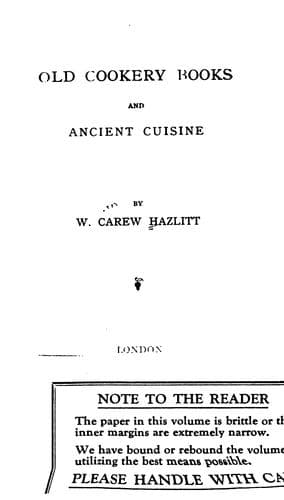
Old Cookery Books and Ancient CuisineHazlitt, William Carew
History
Old Cookery Books and Ancient Cuisine
Hazlitt, William Carew
Cooking -- Bibliography; Cooking -- History
While Mrs. Glasse was still in the middle firmament of public favour,
a little book without the writer's name was published as by "A Lady."
I have not seen the first or second editions; but the third appeared
in 1808. It is called "A New System of Domestic Cookery, Formed upon
Principles of Economy, and Adapted to the use of Private Families."
The author was Helene Rundell, of whom I am unable to supply any
further particulars at present. Mrs. Rundell's cookery book, according
to the preface, was originally intended for the private instruction of
the daughters of the authoress in their married homes, and specially
prepared with an eye to housekeepers of moderate incomes. Mrs. Rundell
did not write for professed cooks, or with any idea of emolument; and
she declared that had such a work existed when she first set out in
life it would have been a great treasure to her. The public shared
the writer's estimate of her labours, and called for a succession
of impressions of the "New System," till its run was checked by
Miss Acton's still more practical collection. Mrs. Rundell is little
consulted nowadays; but time was when Mrs. Glasse and herself were the
twin stars of the culinary empyrean.
Coming down to our own times, the names most familiar to our ears
are Ude, Francatelli, and Soyer, and they are the names of foreigners
[Footnote: A fourth work before me has no clue to the author, but
it is like the others, of an alien complexion. It is called "French
Domestic Cookery, Combining Elegance and Economy. In twelve Hundred
Receipts, 12mo, 1846." Soyer's book appeared in the same year. In
1820, an anonymous writer printed a Latin poem of his own composition,
called "Tabella Cibaria, a Bill of Fare, etc., etc., with Copious
Notes," which seem more important than the text]. No English school of
cookery can be said ever to have existed in England. We have, and
have always had, ample material for making excellent dishes; but if
we desire to turn it to proper account, we have to summon men from a
distance to our aid, or to accept the probable alternative--failure.
The adage, "God sends meat, and the devil sends cooks," must surely
be of native parentage, for of no country is it so true as of our own.
Perhaps, had it not been for the influx among us of French and
Italian experts, commencing with our Anglo-Gallic relations under
the Plantagenets, and the palmy days of the monastic orders, culinary
science would not have arrived at the height of development which it
has attained in the face of great obstacles. Perchance we should
not have progressed much beyond the pancake and oatmeal period. But
foreign _chefs_ limit their efforts to those who can afford to pay
them for their services. The middle classes do not fall within the
pale of their beneficence. The poor know them not. So it happens that
even as I write, the greater part of the community not only cannot
afford professional assistance in the preparation of their meals,
Public-domain text, read in full here on John Shaqi.
Reviews
Reviews
No reviews yet
Be the first to share your thoughts on this work.
Elsewhere in the archive
Join the Discussion
Join the discussion
Sign in to leave a comment or review.
Sign InorCreate an account