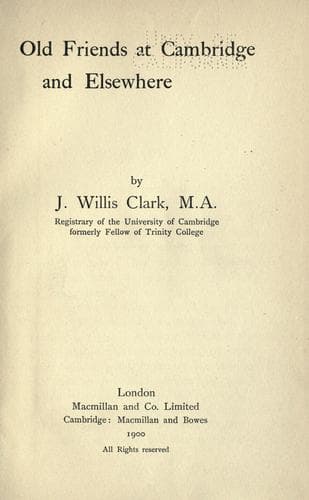
Old Friends at Cambridge and ElsewhereClark, John Willis
History
Old Friends at Cambridge and Elsewhere
Clark, John Willis
University of Cambridge -- History
We have tried to eliminate what we believe to have been the real Milnes
from a cloud of misrepresentations and erroneous judgments—for both of
which, it must be remembered, he was himself directly responsible. We
leave to our readers the task of passing sentence on a singularly
amiable, if eccentric, personality. Some opinions expressed by those who
understood him and valued him will appropriately close this article.
When he was young his friends recognized in him what Dr Johnson would
have called the potentiality of greatness, though they doubted whether
he would have sufficient steadiness of purpose to achieve it. ‘Your gay
and airy mind,’ wrote Tennyson in 1833, ‘must have caught as many
colours from the landscape you moved through as a flying soap-bubble—a
comparison truly somewhat irreverent, yet I meant it not as such.’ ‘I
think you are near something very glorious,’ said Stafford O’Brien, ‘but
you will never reach it.’ Mr Aubrey de Vere decided that ‘he had not
much solid ambition. The highlands of life were not what interested him
much; its mountains cast their shadows too far and drew down too many
clouds.’ But, if Milnes’s well-wishers were compelled to abandon their
hopes of any great distinction for their friend, they recognized, with
one accord, his charity and his sincerity. If they did not admire him,
they loved him. ‘You are on the whole a good man,’ said Carlyle, ‘though
with terrible perversities.’ Forster declared that he himself had ‘many
friends who would be kind to him in distress, but only one who would be
equally kind to him in disgrace.’ A distinguished German said of him,
‘Is it possible that an Englishman can be so loveable?’ and Mr Sumner
described him as ‘a member of Parliament, a poet and a man of fashion, a
Tory who does not forget the people, and a man of fashion with
sensibilities, love of virtue and merit among the simple, the poor, and
the lowly.’ Lastly, let us cite his own whimsical character of himself,
which, though expressed in the language of paradox, is probably, in the
main, nearer to the truth than one drawn by any critic could be:
‘He was a man of no common imaginative perceptions, who never gave his
full conviction to anything but the closest reasoning; of acute
sensibilities, who always distrusted the affections; of ideal
aspirations and sensual habits; of the most cheerful manners and of the
gloomiest philosophy. He hoped little and believed little, but he rarely
despaired, and never valued unbelief, except as leading to some larger
truth and purer conviction’ (vol. ii. p. 491).
EDWARD HENRY PALMER[88].
Public-domain text, read in full here on John Shaqi.
Reviews
Reviews
No reviews yet
Be the first to share your thoughts on this work.
Elsewhere in the archive
Join the Discussion
Join the discussion
Sign in to leave a comment or review.
Sign InorCreate an account