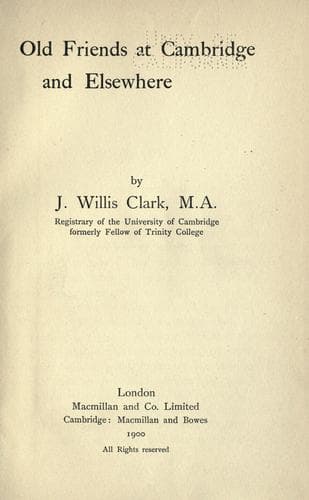
Old Friends at Cambridge and ElsewhereClark, John Willis
History
Old Friends at Cambridge and Elsewhere
Clark, John Willis
University of Cambridge -- History
Palmer’s proficiency in Oriental languages at this time, 1867—only seven
years, it should be remembered, after he had begun to study them—is
abundantly attested by a very remarkable body of testimonials[91] which
he obtained when a candidate for the post of interpreter to the English
embassy in Persia. His old friend the Nawab said:
‘Notwithstanding the fact that he has never visited any Eastern kingdom,
or mixed with Oriental nations, he has yet, by his own perseverance,
application, and study, acquired such great proficiency, fluency, and
eloquence, in speaking and writing three Oriental tongues—to wit, Urdú
(Hindoostani), Persian, and Arabic—that one would say he must have
associated with Oriental nations, and studied for a lengthened period in
the Universities of the East.’
We have no room for quotations from the curious and flowery compositions
in which numerous learned Orientals held up his excellencies of every
sort to admiration; but we will cite a short passage from what was said
by Mr Bradshaw, Librarian to the University of Cambridge, who had
naturally seen a great deal of him while working at the manuscripts:
‘What was at once apparent was the radical difference of his knowledge
of these languages [Arabic and Persian] from that of any other
Orientalist I had met. It was the difference between native knowledge
and dictionary knowledge; between one who uses a language as his own and
one who is able to make out the meaning of what is before him with more
or less accuracy by help of a dictionary.’
In the autumn of 1867, a fellowship at S. John’s College being vacant,
the then Master, Dr Bateson, knowing Palmer’s reputation as an
Orientalist, asked Professor Cowell, then recently made Professor of
Sanskrit, to examine him. Professor Cowell writes:
‘I undertook to examine him in Persian and Hindustani, as I felt that my
knowledge of Arabic was too slight to justify my venturing to examine
him in that language. I well remember my delight and surprise in this
examination. I had never had any intercourse with Palmer before, as I
had been previously living in India; and I had no idea that he was such
an Oriental scholar. I remember well that I set him for translation into
Persian prose a florid description from Gibbon’s chapter on Mohammed.
Palmer translated it in a masterly way, in the true style of Persian
rhetoric, every important substantive having its rhyming doublet, just
as in the best models of Persian literature. In fact, his vocabulary
seemed exhaustless. I also set him difficult pieces for translation from
the Masnaví, Khondemir, and I think Saudá; but he could explain them all
without hesitation. I sent a full report to the Master, and the college
elected him at once to the vacant fellowship[92].’
Public-domain text, read in full here on John Shaqi.
Reviews
Reviews
No reviews yet
Be the first to share your thoughts on this work.
Elsewhere in the archive
Join the Discussion
Join the discussion
Sign in to leave a comment or review.
Sign InorCreate an account